Happy Malaysia Day! (“Looking beyond race” in theSun)

My comment for theSun in commemoration of Malaysia Day was published today, which can be found here.

In the article, I make a reference to 1Malaysia. It was meant to be sarcastic in nature, but unfortunately that little quip was edited out… so it looks and sounds as if I am praising it.

Some other subtle hints I make were also edited, so I think it’s best to publish the article in its original form here. Happy Malaysia Day, everyone!

* Malaysia Day is going to be busy. Just got back from this morning’s Fast4Peace event, a grassroots effort to fast for the nation on Malaysia Day. Was a little late as I only decided to go after I got up for the usual sahur for the month. In the morning our Selangor State Government will be celebrating Hari Malaysia with Menteri Besar and some guests from the East (Malaysia). In the evening, there is the launch of Saya Anak Bangsa Malaysia, at BlogHouse. What are you doing today to remember you are Malaysian? 

Looking Beyond Race: Ethnic Minorities in Malaysia

Tricia Yeoh

Any right-thinking Malaysian should be increasingly disturbed by recent incidents that are rocking the multiethnic boat. These separate events coalesce in our minds into one thing: the nation is riddled with racialist individuals. Whilst Malaysia battles with numerous other problems, ethnic relations is considered the primary wild animal to tame, and rightly so, since without equality of opportunity what pride can one take in one’s birth country?

The feeling of helplessness and disquiet is of course not new. Yes, recently a cow head was stomped and spat on to protest the building of a temple in a Muslim-majority area (cows are sacred to the Hindus). Yes, certain newspapers allow opinion pieces that read, “nothing can stand in the way of ensuring only Malay and Muslim rights are defended”. While one does not want to dilute the severity and gravity of these, Malaysians should not be particularly shocked.

Official policy in Malaysia already sets the fertile ground upon which ethnocentrism can grow and flourish. This has been debated at length, and many view the country’s socio-economic policies as being unable to contribute constructively towards building a united nation. The unfettered overzealousness in ensuring the advancement of a particular ethnic group turned sour over the years, never mind that the Constitution actually emphasises the well-being of all ethnic groups equally. Our race-based political structure does not help either, and has in fact proven instrumental in promoting division.

The nation stands confused and bewildered in the wake of irrational attitudes towards race, a tragedy indeed as we celebrate 46 years of Malaysia’s formation on the 16th September 2009. Our frail attempts at national unity seem to have all but shattered. What has become of mutual respect, understanding and compassion towards the other, all of which form fundamental elements of every religion? What should we make of sloganeering 1Malaysia when with one hand we cradle the platitudes of various motherhood statements, and with the other we fan the flames of racist sentiment?

Without wanting to place labels once again on ethnic groups, since I would rather all consider ourselves Malaysian first, it seems necessary to highlight the ethos of ethnic minorities: How should we react amidst such crazed antics? There are multiple ways in which ethnic minorities in Malaysia could respond to the strange direction the country seems to be taking of late.

The first and most natural reaction against an onslaught – real or imagined – is to retreat into respective ethnic bases, stick our heads into our own little communities, never to return to interethnic life. Unfortunately, this happens more often than not. Ethnic minorities around the world have a general tendency to close in on themselves, creating sub-cultures that overemphasise their own value-systems – like the early Turkish settlers in Germany, for example. Similarly, the danger for the Chinese, Indians and other “immigrant races” in Malaysia is to huddle in their own little club-houses, speak their own languages, build their own schools and produce and read their own newspapers. It is difficult to lobby for equality when participation of these communities in public life lies only within its fringes at best. It is difficult to counter the exclusivist positions when we entrench ourselves in precisely those categories of “immigrant” in which others seek to confine us.

Again, one understands this instinctive reaction, especially given their justified grounds: they feel excluded from mainstream of socio-economic life and hence create smaller worlds they can fully belong to and claim as their own territory. However, harsh as it may sound, this sort of thinking impedes the development of a united Malaysia. It is perfectly acceptable for multiple language to flourish as mediums of education and commerce, and the diversity of literature, resources, and culture should be encouraged. But the promulgation of isolated societies, members of which never see the light of any other community’s day, is unhealthy at best.

The second possible option is to react violently, akin to the ancient law of “an eye for an eye, a tooth for a tooth”. This is obviously immature and mutually destructive. A cow’s head may have been used to upset Hindus, but no one has the right to retaliate by desecrating a pig’s head to insult Muslims – far from it! Without necessarily resorting to physical acts of ridiculous rudeness, however, we have developed subtler ways to point fingers at the other. For example, should a Chinese-language publication spout biased remarks, its justification for doing so would be, “The other side did it first!” This may be so, but where does it end? No one should disgrace themselves by descending to whatever vile levels they think others have sunk. If, by contrast, we were to take the opposite tack of responding to provocation with calm and deliberate reason, would we not at least take a step closer – however small that step might be – towards admitting that we each have the right to be different?

The third and wisest option is the only one available in paving the way forward. The same trend has been developing in recent years in different shapes under different banners: “Anak Bangsa Malaysia”, “Malaysian Malaysia”, and yes even “1Malaysia” (hypocritical as the implementation is under the current government). As long as we continue to consider ourselves separate and divergent, leaders will continue to treat us as such. Whilst cultural diversity should be supported, one’s identity should be primarily identified based on one’s citizenship, that is, in being Malaysian. Ethnic minorities, while being critical of biased affirmative action policies should rise up against their natural tendencies and be counted for their ability to be colour-blind.

This means more than just fuzzy ‘we are all the same’ feel-good pats on the back. It also means the willingness to support institutions of government; for Chinese, Indians and others to work in the civil service; to reform educational institutions with the view of eventually sending all our children to national schools in which children interact with all races; for vernacular newspapers to shed their mindsets of defending only their own communities. Most importantly, we must all step out of our comfort zones and make genuine friends from other communities. We must honestly desire to help those communities that are poverty-stricken, whether they are Malay, Kadazandusun, Indian, Orang Asli, Penan, or Chinese. And we must be able to speak honestly and openly about each other’s religion and cultures.

The danger of bigotry is that it often prompts an equally ugly reaction from the other side. Malaysians of all communities should not stoop to such levels, but instead rise up above the ‘tit for tat’ attitude that, if nothing else, is reminiscent of the insane zero-sum logic that has brought more harm than good to the world.

Furthermore, race is not as defining a factor as socio-economic status, income levels, and other demographics. Let us not fall under the sway of the ‘illusion of singular identity’, espoused by Amartya Sen in one of his books. Malaysians must be responsible for thinking and behaving as Malaysians, for the sake of a truly flourishing united nation.


Tricia Yeoh serves as Research Officer at the Selangor State Government. 

Posted in The Cause | 1 Comment

In Memory of Teoh Beng Hock

Much has already been said about the death of the late Mr. Teoh Beng Hock, political aide to Selangor State Government Exco member YB Ean Yong, and I understand the great anger and sadness being expressed by the public to this effect. I do not know whether what I will share here will be of any use to anyone, but I would like to express my experience of the matter as a colleague of Teoh’s in the State Government (as an aide of the Menteri Besar) in the same Selangor administration. I was not close to Teoh, but being colleagues in the same building we were of course acquainted and I would see him at State events and press conferences.

Words cannot express the deep shock that many of the aides went through when news of Teoh’s death came through. It is no different for me. The fact there this young man, aged 30, was merely assisting in an investigation of the Malaysian Anti-Corruption Commission (MACC) as a witness and not a suspect, fell to his death at the same building the MACC is located reeked suspicious from the very start. Any one of us as aides could have been equally tantamount to the treatment received by Teoh of the MACC – although the facts of this have not been determined – and this has been a traumatic time for all of us.

Deeper than the trauma stirs a great, great anger that is ready to implode. The anger stems from the knowledge that Teoh’s death is a result of MACC’s treatment towards him during interrogations. Teoh was believed to have fallen to his death from the 14th floor of Plaza Masalam, where the MACC’s office was located. The official post-mortem report states that the cause of death was multiple injuries from a high fall. Whatever the reason for this fall – suicide or otherwise – it must be stated clearly that the MACC must be held responsible.

The MACC’s responsibility is to ensure that any case of corruption is investigated and the culprit revealed. The manner in which they acted here was most unbecoming of a Commission that is supposed to be the bastion of justice, transparency and governance. Instead, their actions shamefully display the very reversal of a commitment towards truth.

First, the case began with the mere speculation on someone’s blog that there were State Exco members involved in misallocation of funds. YB Ean Yong was one of the seven assemblymen being investigated, and the accusation in his particular case was that he had paid RM2400 for 1500 Malaysian flags used in Merdeka Day celebrations in 2008, without actually receiving them for the suppliers. The measly amount of RM2400 surely cannot justify the way in which Teoh was treated, interrogated from 6pm till 3.45am of the following day. Surely corruption cases involving millions of Ringgit are more worth the time and effort of the MACC, and not petty cases as this.

As such, even by the largest stretch of the imagination, that if this case was indeed one of corruption, it is absolutely clear that the MACC was overzealous and making a mountain out of a molehill – which in turn causes minds to question its political neutrality. If instructions were given to play up this case – and that of other assemblymen – then the independence of the MACC has all but disappeared. This incident is the final nail in its coffin, from the public’s point of view. It will be impossible for it to reclaim public trust and confidence from hereon.

Second, the manner of interrogations is also suspicious. Boon Hwa, a councillor from the Kajang town municipality, was questioned in the same case and shared at a press conference that the interrogations involved standing at attention for four hours in a row, without food or drink. Threats were made to beat him up, and mention of his family was made, should he not give the answers they wanted. He was jeered at, with humiliating calls of “Cina Bodoh!” shouted at his face – “Stupid Chinese”, an utter racist remark and itself the most shameful display of an institution of the MACC. This is a far cry from the 1Malaysia concept that the Prime Minister Najib Razak has attempted to introduce.

Although this is speculation, many wonder if Teoh was subject to similar treatment. Psychological and mental abuse that may have taken place is not the role of the MACC. It was said that Teoh was inexperienced in this regard, and being for the first time interrogated in an anti-corruption case, could have been shaken and traumatised. Although his lawyer and boss told him exactly what to do and what to say, his frailty may have caused his interrogators to draw greater strength from their imaginary power and muscle.

Third, it is unclear as to whether the MACC did indeed act according to the laws that govern them. I am not a lawyer and this should be clarified with detailed analysis. Whatever the jurisdiction of the MACC, any witness or suspect in a case should be allowed to have an accompanying lawyer. The length of time allowed for interrogation should not extend to the wee hours of the morning. The numbers of officers should be clearly specified, along with recordings of any statements made during the course of the interrogation done – both in audio and video format. If the MACC was acting outside of its legal powers, action must be taken immediately. Again, this is subject to legal analysis.

Fourth, the MACC was responsible for Teoh as he was being interviewed in their premises. Their current claim is that once interrogations ended at 3.45am, Teoh was allowed to return home but instead he requested to rest in their office. Except for someone who saw him at 6am, nobody else apparently saw him until his body was found at 1.30pm subsequently. MACC’s stand is that because he was released, they were no longer responsible for where he went and what he did.

The story seems strange because Teoh had his car parked at the basement of the building. Would it not make sense for him to have left as soon as possible? Even if he did want to rest at the office, his handphone would have been returned to him (since “interrogations were already over”), and some contact would have been established with his friends and family members, surely. However, no communication was made as far as has been reported to date.

The MACC would surely have monitored Teoh’s comings and goings. As a key witness that would warrant such thorough investigations through the night, surely his presence was important. Surely some record would have been noted, of his having officially left the building’s premises. Whatever the case, the response that nobody knew where he was – is weak and irresponsible.

Teoh was a quiet character who must have been thoroughly enthused about working in a new state administration. I cannot speak on his behalf, but the reason I have chosen to work in this Pakatan State government is because I want to contribute to a cause I believe in. To better socioeconomic policies in the view of fairness for the sake of the rakyat. I am sure Teoh was no different. Spurred on by the results of the March 8th General Elections, hope for a budding democracy had begun. Although the actual management and administration of the State has not been easy, nor without error, the struggle to create a better society is real.

As a young person, I resonate with his desire to contribute so willingly to this cause. His death cannot be in vain. Although it may spark fears amongst the young – and their parents – as to the grave political dangers of this working environment, I believe with a greater urgency and fervour that this is the right thing to do.

It can no longer be mere speculation that we as Malaysians are living in a system of darkness, corrupt and unfair practices. The treatment of a youthful, innocent man could be the same treatment given to any commoner on the street should he be hauled up by the MACC. What justice is available to an ordinary rakyat? No, the need to raise up a new generation of people to transform Malaysia to a nation of hope, justice, peace and good governance is even more necessary.

Along with many others, I call for a Royal Commission of Inquiry into the death of the late Teoh Beng Hock. The inquiry must be independent, transparent and conducted by individuals of the highest integrity. This has been a rare first political death of its kind, and should changes not be made immediately to the  rotten system of Malaysia, the question looms dark in our minds: Who will fall prey as the next victim?

Posted in Uncategorized | 29 Comments

1Malaysia and all Reformist speeches all down the drain

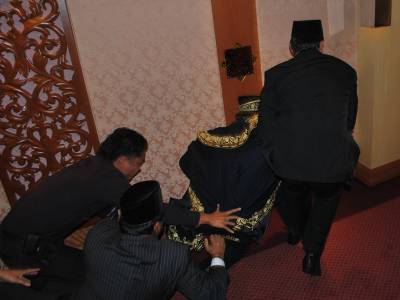
Sivakumar Dragged out of House

This is Sivakumar being forcefully dragged out of the Speaker’s Seat from the Perak State Assembly House by the Police; before Zambry is put on the seat like a little puppet of BN (not like, but is) and Raja Nazrin begins his speech.
Stories here, here and here.
 
This is what democracy in Malaysia has been reduced to: brute force.
 
This week’s incidents clear any residual doubts about whether the 1Malaysia concept would indeed bring a difference. Let me be clear: It will not.
All talk has been effectively negated. Any speech that comes out from here onwards will only reek of rhetoric, which has been the suspicion of many, now confirmed.
 
Any talk of reform will and should, fall on deaf ears from today on. It is akin to the story of the boy crying wolf. Once bitten, twice shy. It is going to be extremely difficult for the current government to worm their ways out of this one. Everything that emerges from official statements about liberalisation and making necessary changes, all the talk about “the era of ‘Government knows best is over'” will now mean absolutely nothing. Nothing.
Posted in Uncategorized | 3 Comments

Reforming Institutions and Separation of Powers

I was invited to speak at the Perdana Leadership Foundation’s Discourse Series. The title of the day was “The Role of the Judiciary, Executive, Legislative and Constitutional Monarchy in the Governing of Malaysia”.

Some people thought I was too oppositionist in bringing up Perak, but come on – there is NO way I could have addressed the audience on this subject without analysing the Perak fiasco. Seriously. And what has happened today has made me all the more adamant that the institutions must be strengthened and complete revamping and reform must take place before the same orchestrated madness of today is replicated elsewhere, or worse – at national level should it come to that stage.

Once the Executive takes into its own hands what it must at all costs achieve, and makes use of all other arms to fulfill its needs, thus spells the death of democracy.

The text of my speech is here. (I shall upload all my speeches of the last few months too – haven’t had time la, have been so busy with Selangor work).

“Restoring Institutional Strength and Separation of Powers”

Wednesday, 6th May 2009, Perdana Leadership Foundation 9th Discourse Series, Putrajaya

Tricia Yeoh

Salam sejahtera and good morning. I have been asked to share my thoughts with you on the role of the judiciary, executive, legislature and the constitutional monarchy in the governing of Malaysia. My co-panelists, both trained in the law, would no doubt present a complete and thorough legal framework, so I thought that I’d try to capture the sentiments being more urgently and widely expressed by many Malaysians. The viewpoint which you will be sharing with for the next few moments will be that of a person working in government presently, exposed to its systems and cultures, a keen political observer, and a young Malaysian serious about reflecting upon the country’s problems and trying to resolve them through key public policy reforms.

One cannot reflect upon the role of these institutions – the judiciary, executive, legislative and the monarchy – without first examining the political structure that was intended for the governing of Malaysia. Our country was one of those Commonwealth countries that was expected to and for a while held out the promise of blossoming into a mature democracy. For this reason, it is worth considering the challenges encountered by these institutions; how their roles have been shaped; or where they have not been reflected in their practice; and how they can be improved, in the process of truly gaining a full-fledged democracy in the medium to long run. The Reid Commission Report clearly demonstrated the difficulty of achieving a fine balance of interests between the different sizable racial communities that had to be accounted for within a constitutional government akin to the British Westminster model. But did our past leaders envisage the fruition of a democracy in our country?

Tunku Abdul Rahman on 16th September 1963, the day Malaysia was formed, said, “Let us always remember that the Malayan Union was formed after many difficulties during a long period of national Emergency, yet its multi-racial society emerged, endured and survived as a successful and progressive nation, a true democracy and an example to the world of harmony and tolerance.” Malaysia’s formation was complicated by a host of factors: citizenship, cultural heritage, the Emergency, ethnicity, religion and so on. Despite this, and at the end of it all, our achievement should have been a true and healthy democracy; one where we are debating about the finer points of the rule of law and separation of powers, and not whether it exists or not. The rule of law simply means that no one is above the law. Not you. Or the police. Or the judges. Or even the Prime Minister. And in some cases even royalty. Everyone of us are supposed to be equal before the law.

Continue reading

Posted in Uncategorized | 1 Comment

Unfettered powers of the executive

Unfettered powers of the executive 

(First published in Malaysiakini on 8th April 2009. This was a speech delivered to the UKEC 6th annual conference in London).

Contrary to popular belief, I am not related to Michelle Yeoh, YTL or my former boss Michael Yeoh. I do not even come from a family of politicians. I am here because I simply happen to share the common ideals and principles that I hope many of you have and have acted upon them.

As introduced, I work at the Selangor state government with a team of young people, others like myself, and it is an honour for me to work and serve the state to implement policies and ideas in a concrete way.

It is of course an honour as well for me to join you at your sixth annual conference, more deeply so as a fellow Malaysian. The pleasure of being here, however, is somewhat marred by the disturbing crisis looming large back in our homeland. Perhaps it is a strange coincidence that you have timed a conference that confronts and discusses steps forward for Malaysia on the very weekend after the new prime minister has taken over the helm; and the very same weekend before three explosive by-elections are held, the results of which will stand as the litmus test for Najib Abdul Razak’s popularity and the new administration’s legitimacy.

More serious is the question posed to the panel today, on whether democracy is working well in Malaysia. I have to be honest – I stifled an immediate need to laugh when reading the question. This laugh stems from my utter amazement at the current administration’s complete disregard of the rule of law in recent political developments, without which a country effectively runs close to being a lawless state. If anything, Malaysians stand at a turning point in history, observing war being waged against democracy itself.

Democracy is of course a debatable and subjective concept, but the one I choose to take comes in the form of upholding key principles like social justice, the rule of law, separation of powers, equal rights and public consultation.

The Perak fiasco

Indeed, it has been recently pronounced by many that the Federal Constitution is dead. What happened in the Perak fiasco would warrant one pronouncing its state constitution as equally so.  I will not discuss the reasons for which this happened, but the fundamentally wrong way in which it took place – not the ‘why’ but the ‘how’.

This was a case in which the fate of its state government hung precariously upon the shadowy negotiations of three individuals and the amount of cash being exchanged. A case in which the forced resignation of the menteri besar was unconstitutional, where the Perak constitution does not empower the Sultan of Perak to forcefully dismiss the menteri besar. Article 16(6) states that where a request for dissolution of the state assembly is refused by his highness, as a result of the menteri besar ceasing to command the confidence of the majority of the assemblypersons, the incumbent menteri besar has to tender the resignation of his executive council and the menteri besar is to be removed.

What is not clear – which is an assumption made by those in recognition of Zambry Abd Kadir as the new menteri besar today – is his highness’ jurisdiction to decide on his own accord that the incumbent menteri besar did not command the confidence of the majority of the assembly, even without a vote of no confidence. In the Sarawak case of Stephan Kalong Ningkam, a vote was necessary to determine that its chief minister actually did eventually command the confidence of the majority. Likewise, a vote of no confidence should have been conducted to finalise the status of the incumbent menteri besar, especially since one, speculation of money politics was rife and hence legitimacy of position as representative of their constituents dubious; two, the majority was ever so slight; and three, the assemblypersons in question were not even BN party members but merely ‘BN-friendly’, a position so vague that could easily have shifted around the very next day.

The descent into chaos was immediate: again, a constitutional crisis in which the separation of powers was clearly not adhered to. You had a situation where the Federal Reserve Unit blocked entrance into the state assembly although as an executive arm, it had no right to interfere into matters of the legislative. That said, the speaker’s position and role has not changed as of today. If the state assembly does not sit for a period of three months, it will be dissolved – and his highness would now have to call for fresh state elections.

The Perak case, combined with the situation last year where the Sultan of Terengganu dismissed the prime minister’s recommendation of a menteri besar preferring his own candidate, has thrown into public debate the role of the monarchy in Malaysia. More distinctly in the past week has been the question of the Yang di-Pertuan Agong’s appointment of the prime minister.

Nowhere in the Federal Constitution does it state that the president Umno immediately assumes the position as prime minister of Malaysia – this has only been a matter of practice and precedence.

In fact, the king has sole and absolute discretion in how he forms his judgment as to who in the Dewan Rakyat commands the confidence of the majority. Although he did decide to appoint the current prime minister, the possibility of his ability to do otherwise has triggered the question of just how strong a role the royal prerogative should play. The interpretation and practice of the prime minister’s responsibility to ‘advise’ the Agong is obscure.

Role of the monarchy

In fact, the Federal Constitution requires the Yang di-Pertuan Agong, on advice of the cabinet or minister, to consult with the Conference of Rulers on the appointment of members of the judiciary, the auditor-general, members of the Election Commission, Public Services Commission and education commission. Recent trends to reduce the role of the Conference of Rulers include the Court of Appeal’s decision in 2000 (in the matter of an oral application by Anwar Ibrahim to disqualify a judge of the Court of Appeal, 2000, 2 MLJ 481), that the Agong may consult the Conference of Rulers but does need its consent. However, note that even amongst the Malayan representatives the original intent was for the Conference of Rulers to play the role of constitutional consultees (Chin, 2008). Such conventions have been forgotten, more so after the 1993 Federal Constitution amendment which reduced the monarchy’s immunity further.

If the independence and sturdiness of each of society’s pillars characterise a democracy, then Malaysia fails miserably in that its executive has taken on an increasingly prominent position, overriding that of Parliament, the judiciary and the monarchy. The constitutional amendments in 1988 and subsequently over the years weakened these institutions whose powers were meant to keep the other in a situation of check and balance.

What happened in Perak was not necessarily proof of the monarchs’ strength but their unhealthy collusion with political individuals. The subversive political influence exercised by the Executive permeates all possible agencies, including the Police, Civil Service, Media, as well as apparently independent Commissions.

I refer here to the two most commonly spoken of: the Malaysian Anti-Corruption Commission and the Judicial Appointments Commission. Long-awaited, they were hurriedly passed in Parliament before then prime minister Abdullah Ahmad Badawi retired from office. The MACC differs from its predecessor in that its director-general now enjoys unprecedented independence similar to the attorney-general, auditor-general and judges.

Touted as amassing greater powers than before, it could lean both ways – either good or bad. However, given the bad past track record of leaders, for example here advisory board members are appointed by the Yang di-Pertuan Agong based on the prime minister’s advice, once again reflective of the executive’s strong influence being exerted. There are several committees that are supposed to keep them in check, such as the Anti-Corruption Advisory Board, Special Committee on Corruption, Complaints Committee, Operation Review Panel and the Corruption Consultation and Prevention Panel – but the unfortunate thing is they are all selected by government and not cross-party panels, which is more ideal.


Similarly, the Judicial Appointments Commission’s members are selected at the discretion of the prime minister. This is cause for concern as former politicians might be appointed at his will.

Although not foolproof, this is a step in the right direction, where for umpteen years the current legal system has been ridden with the lack of transparency and accountability in judicial appointments and the Executive’s interference in the judiciary. It is hoped that by providing some counsel, judges would be selected and promoted in a more transparent a manner. Neither of the two Commissions, of course, is placed under the jurisdiction of Parliament. How well either achieves its objectives depends on how violently the Executive pokes its nose into their affairs.

You see now that the problem of separation of powers in Malaysia – or the lack thereof – has led us down a slippery slope. The original Westminster model envisioned by the Reid Commission when formulating the Federal Constitution’s contents has failed miserably. Several factors have led to this situation, namely the historical need for the then Alliance to form a strong central administration, being Malaya’s first Government.

More realistically, the Emergency period from 1948 throughout the 1950s exacerbated the need to curtail freedoms in the form of the Sedition Act 1948, the Printing Presses Act 1948 and later the Internal Security Act (ISA) 1960.

What ‘national security’? 

Consider this. Malaysia is one of the only countries in the world whose Constitution allows preventive detention without trial during times of peace. This has been said numerous times, but worth repeating that the ISA goes against the very fundamental human right to fair trial. The ISA provides for preventive detention without trial for two years, renewable indefinitely in subsequent two-year terms if the minister is “satisfied that the detention of the person is necessary to prevent [the detainee] from acting in a manner prejudicial to the security of [the country] or to the maintenance of essential services therein or to the economic life thereof [Article 8(1), ISA 1960].

Although during different premierships the ISA was used for very different purposes, the arbitrary manner of deciding on its application is too highly dependent on the individual personality of the prime minister. We cannot rely on the particular PM’s “mood of the day” or personal character. For example, while Tun Ismail maintained that the ISA would not conflict with democracy and the rule of law, the same cannot be said of the way in which Dr Mahathir flexed his muscle through the same Act.

We cannot rely on the goodwill of a leader, but instead on a system to keep all in check, no matter his character. The argument often used is that of “national security”, which seems to encompass a broad ambit with anything remotely affecting political, social, economic, and developmental stability. While it is true that some level of measure is necessary to ensure stability in a multiracial country such as ours, it is only with an equal respect for and genuine practice of good governance and the upholding of the rule of law that this measure is evenly applied.

This has unfortunately not been the case in Malaysia. There are exceptional situations, of course, in which there exists the very real threat of terrorism at the hand of an individual or a group, whose actions need to be curtailed immediately. In such circumstances, there would have to be solid and reliable intelligence and evidence gathered, without any other legal option. Detainees would also have to be subject to adherence of international human rights laws, without torture, humiliation or degrading treatment.

10,662 people have been arrested under the ISA in the past 44 years, with 12 executed between 1984 and 1993. There are 27 detainees now, minus the thirteen to be released tomorrow. Last year saw arrests of journalist Tan Hoon Cheng “for her own protection”, Member of Parliament Teresa Kok for an offence she did not commit, and blogger Raja Petra Kamarudin for offences he was already being charged for under the Sedition Act. How the ISA is deciphered is subjective, its use too easily tied with ulterior motives. It has been much too easily abused and misused for the sake of securing even greater power to those already in positions of authority. There are no two ways about it: the ISA must be repealed.

Living in precarious times 

Malaysia’s National Human Rights Commission, Suhakam, has also recommended its repeal in the long term, calling for judicial safeguards and checks and balances to prevent abuse of fundamental freedoms and undermine legitimate dissent. As it is, the nation is invariably subject to such abuses, especially so since we are still technically under Emergency Rule because none of the proclamations have been revoked.

Yesterday the new prime minister was sworn in. Today is effectively his first day in Office. We are living in precarious times that warrant great leadership. That his has started with the lifting of the banned newspapers and the release of 13 ISA detainees is a good sign, but this does not take away from systemic flaws. Other ridiculous Executive decisions still exist, like barring all Pakatan representatives from entering any national school in Selangor; practice of the Sedition Act, Official Secrets Act, University and University Colleges Act, treatment of refugees, abuse of Police powers, non-independence of the Judiciary – all these do not, in my opinion, augur well for the trend of things to follow. It frustrates me that we can stand for gross unethical and unconstitutional acts, yet continue to call Malaysia a democracy.

I believe that the Malaya, and Malaysia, envisaged by her founding fathers is a far, far cry from where we are today. The flaw of the Federal Constitution is that its crafters assumed that its future leaders would remain gentlemen about this concept of “democracy” and certainly did not predict the rise of authoritarianism that we have experienced in the form of  Mahathir. Certain fundamental principles must be returned to if we want to restore our credibility, reaching beyond our current limited heights. This mode of crisis can leave many in despair, but it can also compel us to drive ourselves even harder against the tide of unfettered displays of power and arrogance. Blatant abuse of Executive position must stop. Upholding the rule of law, separation of powers, limited government, freedoms of the people, and the rightful understanding of the role each institution plays are basic building blocks of any nation.

Friends, we have to acknowledge that we are in crisis mode and at a crossroads. You are all here as young, 20 something year olds, intellectual and articulate. You are here for a reason, and I believe you share many of the ideals I have spoken about. We also recognise that the system we’ve had simply does not work. We must use this opportunity to reverse past wrongs and reorient new trends, policies, plans for the future of Malaysia – for your generation, and that of your children. If you are not idealistic now, then when? If you don’t lay out an alternative plan for the country now, then when?

We only have this second chance to get the equation for a democracy right.

For all our sakes, and for those yet to come, let’s get it right this time round. Thank You.

Posted in Uncategorized | Leave a comment

Dialogue between Selangor and the Orang Asli

The weekend was a busy one, and one of the mini-Everests we achieved was having an inaugural dialogue session between the Selangor Menteri Besar and the Orang Asli community in Selangor. I personally found it incredibly rewarding to be present at this historic occasion. 

The Orang Asli themselves were extremely excited, since it was the very first time ever they would be having an official dialogue with the Selangor State Government represented by the Menteri Besar. They were mainly Temuan, but other communities also showed up from far and wide. All in all there were about more than 500 Orang Asli seated in the hall, in Bukit Lanjan. 

It was quite a beautiful sight, having all of them with their “lilitan” on their hands (a woven headpiece). 

They presented a brief history and background of the Orang Asli to the MB and the other officials present, and then some speeches and thereafter a question and answer session. 

The main demands of Orang Asli are on land rights. They have been extremely frustrated over the fact that their rights to land have not been sufficiently recognised. There is much contention over this issue right now, and various takes of it. To my mind, Orang Asli land has to be recognised and gazetted – and proper land titles given to them who live atop it. Specific demarcations have to be done, so they are not robbed of these rights in the future when and if some commercial developer comes up to take it away from them. 

One of the commitments is to now expedite the process of dealing with the stalemate of Orang Asli land in Selangor. One of the great things the Pakatan Rakyat government in Perak did was to form an Orang Asli Taskforce, headed and led by Orang Asli themselves. They would then deal with these problems and report it to the Exco. This was applauded by many. 

Similarly, I think we will see things moving along in Selangor. The Bernama news report quoted the MB as saying that the existing Selangor Land Task Force would be meeting with the Orang Asli Taskforce soonest possible. Yes, I am looking forward very much to the formation of an OA Land Taskforce for Selangor. 

This would work wonders in terms of moving forward and determine once and for all the problems that have for far too long plagued our very own native community of Selangor. They have lived here for hundreds of years, and imagine their dignity and honour being taken away from them systematically over the last 50 years. Only now is their maruah being returned to them. 

I was deeply moved, listening to the humble pleas of the representatives from 7 districts in Selangor (Hulu Selangor, Kuala Selangor, etc.) – I suppose I’ll be poring over these over the next weeks! 🙂

Posted in Selangor | 6 Comments

Selangor MB meets the Bloggers

It is interesting to observe the different takes that the bloggers took, on the recent “Dialogue with the Menteri Besar” on Sunday evening. You can view their reports of the event to get a holistic picture of what happened and was said, so visit the blogs of Nat Tan, Datuk Kadir Jasin, Rockys Bru, and others who were present but haven’t blogged about it yet included Haris Ibrahim, Khoo Kay Peng, Nuraina Samad, Malaysia Waves (through his representative), Dina Zaman, the Loyarburok team, Patrick Teoh and Fahmi Fahdzil. There was a whole range of others who were invited, or who will be invited in the next round – but we had a good group of people to discuss the issues of Selangor with. 

Certain quotes have been taken from the meeting, and they have been discussed in the comments sections – quite interesting as well to observe these. 

It was a fairly honest and critical session, where the bloggers stated in no uncertain terms their grouses and keen interpretations of their take of the Selangor government a year after. They pulled no punches in stating the facts to their minds. Some raised the issue of communication, which in a sense should push us to ensuring the messages are reaching the ground level people. Especially when there are policies and plans in existence but word is not getting out. 

The purpose of the session – as was mentioned – was to acknowledge the important role that blogs are increasingly playing in shaping opinions, reaching the numbers of people and communicating with them in a fluid way, bloggers are becoming the “ears and eyes” of the people, a conscience, independent watchdogs and so on. Whether in praise or critical, blogs in Malaysia can change how people view matters of public life. Continual engagement is necessary. 

It was held in a rather informal atmosphere, where people were able to speak their minds freely – and yet, all in a very cordial setting. This is the kind of dialogue I think is worth having, and should continue. In an environment where people feel they can give feedback – whether for the purposes of being constructive or not is a different matter altogether – and know that their responses are being taken into consideration seriously. 

All the feedback provided much food for thought, and these are all scribbled into my steadily-filling-up notebook (it’s halfway through and I’ve only been here a month and a half!) (and it’s a thick book) – but I am very glad that we had this session with the bloggers. As someone mentioned, it could have happened sooner, but a hundred-mile journey always begins with the first step. 

Following on from this, I can see possible outcomes from the session branching out in multiple manners. Let’s see what can be done, and you’re welcome to provide feedback here also on what you think!

Posted in Selangor | 4 Comments

Water, Water Everywhere

“Water, Water Everywhere and not a drop to drink” is the quote most often in my head these days. No, I haven’t been obsessing about Coleridge’s “Ryme of the Ancient Mariner”, but have been rather involved in the water restructuring issue in Selangor recently. 

It’s actually a water fight, more like it. The Edge has a good report here.

Although it’s the financial and business news that’s been reporting on it mainly, I think the issue is beginning to take ground amongst the main papers and some blogs. Which is good because this is going to affect ALL consumers in Selangor and Kuala Lumpur. 

What is happening and why is it so important? In short, the Selangor water industry is in the midst of getting restructured. All this needs to be resolved by end of March or there will be a 31% tariff increase. 

The original plan was for the Selangor State Government to negotiate with the concession companies to buy them over. But before the offer expired, the Federal Government stepped in and announced it would negotiate directly with the concession companies because the State was taking too much time. They have sidestepped the State completely and this amounts to sabotage.

This is really bad news for us all because: 

  1. The Federal Government will be dealing with their crony companies Syabas and Puncak Niaga behind closed doors. More shady wheeling-dealing that has been going on for too many years. 
  2. The Federal Government will offer a higher price for the companies’ assets (compared to the State’s offer) and this is actually a Backdoor Bail-Out because they are heavily in debt today. 
  3. There will be a tariff increase in water as opposed to the State which is fighting to ensure NO tariff increases at all.
  4. The Federal Government will most likely continue to use Syabas as a licensed operator and we all know how bad the quality of water and services is today – just think about the quality of water you are receiving today at home… 

There have been a lot of silly statements coming from the Federal Government recently, and it’s tough because it can be a media perception war. And we all know what/who controls the media. 

For example, the Minister of Energy, Water and Communications said that they took the lead in negotiations for other states and were only “allowing” the Selangor State Government to take the lead. This is rubbish, because Water is a state affair. Please read the Federal Constitution. Water is listed under the Ninth Schedule as being a matter of the State. See here. 

Also, the decision to allow the State to lead negotiations was a Cabinet directive. Unless this decision has been revoked (which has not taken place), the State still has the mandate to be involved. Third, it is contravening the Water Services Industry Act 2006 if the State is excluded completely from these negotiations. Obviously, the State Government HAS to be involved – it is ridiculous to exclude the State from any decisions on water.

This exercise is an admission of the failure of privatisation. The Government privatised water, made the people lose out, and now in the de-privatisation process wants to benefit and prosper the rich crony companies yet again. Once bitten, twice shy, the saying goes. The people are wiser than that. 

CEO of Puncak Niaga Tan Sri Rozali Ismail was reported to have received RM5.1 million in 2007 as Director’s Fees. He claimed that “one must be willing to pay for a professional”. As far as I know, he is a lawyer and has had little experience in the water industry, much less a major international player. 

The bottomline is this: the Federal Government cannot bail out these crony companies. For the sake of the people whose taxpayer’s money will go to filling these greedy little pockets, this backdoor bailout should stop. 

Water, tolls, highways, hospitals, sewerage, and so on… all these are public utilities that should never have been privatised in the first place.

Posted in Economics, Selangor | 5 Comments

Universal Periodic Review of Malaysia’s Human Rights

There is a team of people comprising NGOs who are right now in Geneva, Switzerland, attending the Universal Periodic Review which is organised by the United Nations Human Rights Council. Malaysia’s national report is also being presented there. The UPR is basically a review of countries’ human rights records and this is the first time Malaysia is being reviewed.

Based on live feedback coming to us from Geneva, the consultation with NGOs has been rather perfunctory.

Also, Malaysia’s presentation at the UPR is apparently not truly reflective of what has been taking place on the ground in the past year(s). We cannot really forget the numerous incidents of human rights abuses that have stared us in the face including the multiple ISA arrests, the death of Kugan in police custody (which is only the tip of the iceberg really), the adamant refusal to admit that the migrant workers and refugees in Malaysia are treated shabbily to say the least.. and the list goes on.

In any case, I will leave some of those attending the session to tell the story with the press statement below.

Malaysia’s First UPR: Too Much Praise, Too Little Progress


The United Nations Human Rights Council conducted its inaugural review of Malaysia’s human rights record today. At the Universal Periodic Review (UPR), Malaysia’s national report was presented by Tan Sri Rastam Mohd Isa, Secretary General of the Ministry of Foreign Affairs. The Attorney General, Tan Sri Abdul Ghani Patail, and Datuk Faizah Tahir, Secretary General of the Ministry of Women, Family and Community Development made additional statements. Representatives of non-governmental organisations (NGOs) from the Coalition of Malaysian Non-Governmental Organisations in the UPR Process (COMANGO), and the Jaringan Orang Asal SeMalaysia (JOAS) were present. Representatives of the Human Rights Commission of Malaysia (SUHAKAM) also attended.


The UPR process compels the government to critically assess Malaysia’s human rights record, in consultation with SUHAKAM and NGOs. However, the consultation with NGOs has been superficial, patchy and cursory.


Malaysia’s presentation during the review today described some of its successes without acknowledging any shortcomings. The government highlighted the overall reduction of poverty but failed to address the increase in income disparity, e.g. within the Bumiputra community.


Malaysia also made some inaccurate statements. “The government claimed that the rights of indigenous peoples were well protected under existing legislation. Mexico and Qatar correctly raised the issue of the rights of indigenous peoples which needs better protection. I urge the government to accept Mexico’s recommendation to ratify the ILO Convention No. 169 concerning Indigenous and Tribal Peoples in Independent Countries. I am also disappointed that the government only mentioned Orang Asli and the Penans thus leaving out the other indigenous groups in Sabah and Sarawak,” said Mark Bujang of JOAS. According to Giyoun Kim, UN Advocacy programme manager of the Asian Forum of Human Rights and Development (FORUM-ASIA), “With all the several country visit requests made by the Special Procedures mandate holders since 2002, the Malaysian Government only repeated its rhetoric excuses that it remains open to further discussions and is willing to consider the requests positively on the merit of each proposal. It is regrettable that Malaysia, as a member of the Human Rights Council, did not present any will to closely cooperate with the Special Procedures by way of declaring standing invitations to these mandate holders to visit Malaysia, as encouraged by several countries.”

Continue reading

Posted in Uncategorized | 1 Comment

Selangor to take over Water Concessionaires’ Assets

I will be putting up the Selangor press statements on my blog. The first one here is on an issue that is really quite an urgent one: the restructuring of the Selangor state’s water industry. I hope people will understand the importance of this whole deal. There’ll be a public briefing to be held soon to clarify matters. I’m looking forward to it.

STATE GOVERNMENT IS PREPARED TO TAKE OVER SELANGOR WATER CONCESSIONAIRE’S ASSETS

SHAH ALAM – The Selangor State Government is serious in ensuring that the restructuring of the water services industry in Selangor is implemented effectively, to provide maximum benefit to the people.

After six months of being engaged in the process of restructuring the water industry that has involved multiple parties, the State government is now ready to make an offer to take over the assets and equity owned by four water concession companies.

The State Executive Council has agreed today to release the offer letters within these two days to the four concessionaires, which are Konsortium ABASS Sdn Bhd (ABASS), Puncak Niaga (M) Sdn Bhd, Syarikat Pengeluara Air Selangor Holdings Berhad (SPLASH) and Syarikat Bekalan Air Selangor (SYABAS).

Before making this decision, the State Government, through its Water Review Panel that was established to review the restructuring process of the water industry in Selangor, has conducted a detailed study into the valuation and calculation of all companies’ assets and equity. It must be stressed that public interest was of primary importance when making this decision.

The State Government’s offer to all concession companies is one that is fair, taking into account the considerations of all stakeholders and will not negatively impact any of them. The rate of return and profit that will be earned by the companies is considered as fair.

It is the hope of the State Government that all parties will agree with this offer, in order that the restructuring process of the water services industry in Selangor is implemented before 31st of March, at the request of the Ministry of Energy, Water and Communications. The co-operation of all would avoid any increase in water tariffs, which if implemented would burden the rakyat especially during an impending economic slowdown.

The State Government is aware that the restructuring of the water industry in Selangor affects its residents and feels that the rakyat has a right to understand the issues involved. To that end, the Selangor Menteri Besar’s Office will hold a Public Briefing on a date to be soon announced. The Briefing is to provide updates and information on the situation to all stakeholders in the state, especially since the issue is one that needs complex analysis and explanation.

The public will then receive background explanations on the restructuring process of the water industry in Selangor, with relevant information, and the direction the State Government is headed in the entire process.

The Briefing is expected to be attended by industries affected by the water industry, policy makers at state and national level, civil society, non-governmental organizations, academicians, the private sector and members of the public.

PRESS SECRETARIAT

PEJABAT DATO’ MENTERI BESAR SELANGOR

Posted in Uncategorized | 1 Comment