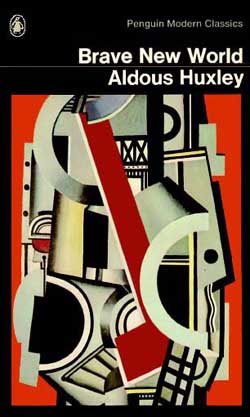
Brave New World

Read one of those books I “should have read but never got round to” over the weekend: Brave New World by Aldous Huxley. Written in 1932, it had an insight too deep for its time. Predicting that humanity would be reduced to merely that of continuous pleasures. In order to maintain a socially stable society, it was necessary to remove all possible barriers to pain and sorrow. This included pregnancy, parenthood, love, monogamy, individual opinion, personal feelings.

And in its place you had an order all too perfect and complete: the breeding of babies in test tubes, altered according to the purposes for which they would eventually serve: the Alphas, Epsilons and Betas and so on. Each class of infants would be socially conditioned into believing this was the caste for them – there was no way out.

And if ever there was the feeling of restlessness or being disturbed at anything in this Order, you would pop a pill of soma in, or a number of them, depending on how long you would like to escape into another world. Soma relieves you from depression, pain and suffering on this earth – instead transports you into a paradise, an ethereal world inside your head.

How far are we from this, really, 74 years after Huxley had that brilliant idea? Let’s think about it. You have a pill-popping nation. Think Prozac Nation. Think all sorts of medication that allow one to transcend the painful, real world – which eventually can kill, if not your body, your mind, your heart.

Social conditioning. What really has society been socially conditioned to believe? That certain things are necessary in order to keep society in its comfortable place and position? That anything out of the ordinary will ruffle feathers, step on the growling lion’s toes so an implosion is bound to take place?

And then of course you have the Savage, named so because of his believed and presumed position – uncivilised. But oh how much more civilised this creature is! Because of his knowledge of Shakespeare and how this means the world. The question of what reality is arises. Where from do we draw inspiration? The perfect squeaky clean sterile environment? What is a perfect society? Is it really necessary to impose regulations such that all and all alike behave the same way, subscribe to the same teachings?  (Huxley goes the extent, proving that the most ridiculous of beliefs can be imposed upon us – something to think about.)

In the end, the book (like Orwell’s 1984) provokes questions that are applicable in both the political and spiritual realm. Politically, what level of control is leveraged upon a nation and citizens to achieve social stability but giving up individuality? Spiritually, what sort of happiness is false happiness? If it is imagined and imposed, does it become genuine? Is perceived happiness truly happiness? Personally, I choose pain and gore. Give me the fight, the furious battles of suffering and blood. Also give me emotion, happiness, elation, frustration, love, truth and freedom. O Brave New World is not so brave and not so new after all…

Posted in Literature, Philosophy, Reflections | Leave a comment

Thoughts on Kuching

Kuching is a beautiful city, with a river weaving through its heart like a silver snake, alight with tiny lights and stalls at night with friendly folk chitting chatting to the other, the slow wooden boat sliding across the water’s surface with war-like shouts. Gambir Sarawak sold on sidewalks unbeknownst to innocent female folk. Powerful scents seeping through the air, turn around and find a lion in your face, many of them dancing and swirling in a trance of drums.

People civil and kind, clean city with hardly trash around. We have much to learn from Sarawakians. Most of all, less ethnically polarised than us in the West. You see people from different races sitting at the same table, eating and dining, chatting like the oldest of buddies. Colour is not so much a dichotomous black versus yellow versus brown versus white.

No, colour in Sarawak has little meaning, as they are merely different shades of the same source of earth. With no distinction that markedly differentiates one from the other, each can comfortably share food and space, the little of civility that we in the West have failed to achieve in recent years.

Issues seep in and out, but the great big white Parliament still stands far away from their pearly River in Kuching.

And yet, yet I am drawn to the enchanted mystical beauty and lush forests, mountains of the other side. What is it worth to satisfy your mind and not your soul?

Posted in Personal | 1 Comment

Away but Back Refreshed

I’ve been gone for some time, both physically and mentally trying to figure some things out, but am now back and refreshed. Quite strange is the way a blog can take a life of its own while you are away investigating and thinking about things. My site visits have tripled while I was away, mostly due to the search engines and what has come up in the meantime: “picture of lina joy”, “lina joy photo”, “lina joy case in malaysia”, “sejarah malaysia” and so on, repeatedly. This is a mark of what interests the public, ain’t it?

Posted in Uncategorized | Leave a comment

Gen M

We had our Generations X and Y, but now has come the time for Generation M, or so it seems according to this new website “Gen M Web“.

Calling themselves true-blue supporters of ex-Prime Minister Tun Dr. Mahathir, they are arranging as welcoming party for his arrival at the Subang airport. The coalition of more than four hundred folk seem to really treat him like a celebrity, with pictures of him plastered all around the website, selling T-shirts and car stickers… this looks more like a music pop group fan club!

Much of this has been sparked off by Dr M’s rather vocal attacks at current Prime Minister Abdullah Badawi on a number of issues, the most controversial of which includes the running of the country by default by his son in law KJ.

Tun M certainly seems to be on a roll these days. Wonder what’s up his sleeve. Finally, for a bit of comic relief, have you heard of the Institute of Tun Dr. M’s Thoughts? I thought that was hilarious. But on a serious note, let’s really see what this Generation M, hardcore diehard fans of our old regime, is up to.

Posted in Uncategorized | 2 Comments

The Original Folk

Colin Nicholas, through his organisation, the Centre for Orang Asli Concerns, is doing a great job through his prolific writing and commitment to the Original Folk in Malaysia. On his website (Temiar) is the following extract:

The other categories that are used for the Orang Asli are based on ethnic and cultural criteria (Roseman 18: 1991):

  • Senoi: including the Temiar and Semai
  • Semang: include the Lanoh, Semnan and Sabum and all the Northern Aslian speakers except the Chewong.
  • Aboriginal Malays: including the ; Temuan, Jakun, Orang Kanaq and Orang Selitar.

Each group Orang Asli group has its own language, history and customs that are distinct from each other. It is popularly believed that the first Orang Asli may have come to Malaysia about 50,000 years ago through population movements from India, Sri Lanka and South China. (Roseman 1991: 18- 19).

The Malays(who make up 55% of the countries population) are not descendants of the Orang Asli but came to the peninsula about 3-4000 years ago. But it was not until relatively recently that the Orang Asli started being displaced from their homes and traditional land by government sponsored and Western backed development including: logging, dams, plantations and golf courses. Their resources have been destroyed and inadequate compensation (if any) has been supplied such as regrouping them into ‘schemes’ with inadequate land or aid for growing food let alone any cash crops.

Today the Orang Asli make up less that 1% of the total population in Malaysia.

I am in a research mood. I’m going to get my hands on books and materials related to this matter. Strangely enough, few of us know anything about the above issues, much less the actual facts that are highlighted. Click on this to read more about the Orang Asli in Malaysia.

The map below shows the areas in Peninsular Malaysia in which the different tribes live in.

It gives you a mysterious feeling knowing you are but a newcomer into a world that was occupied and lived in thousands of years ago by this humble group of people,the forgotten of Malaysia.

Posted in Reflections, The Cause | 1 Comment

IPCMC forward

The IPCMC, or the recommended Independent Police Complaints and Misconduct Commission, has been supported by the Deputy Inspector-General of Police, Musa Hassan! Surprise, surprise.

This is indeed a mini victory for the country’s whistle-blowers, since they were the ones who actively campaigned for the IPCMC to be set up, as an independent commission investigating any wrongdoing within the police force. This tells us that truly, it is essential to have a check-and-balance system within and from outside the government.

Previously, the police force rejected the recommended IPCMC because, according to its website, it would undermine the ruling coalition’s power, and will be a threat to national security.

How it is interpreted as a threat to national security I am clueless about. Surely something as basic as a commission to investigate any wrong action should be supported. If one rejects a right, by default one admits to a wrong – or Fear of a wrong being revealed. If there is nothing to hide, can one not bare all?

Okay now, since the statement is out and official, there is no time to lose. These words cannot be taken back once made, because the citizenry has noted its acceptance. But truly, let’s see how long it will take for it to be actually implemented…

Posted in The Cause | Leave a comment

Christians in Politics

I picked up a book at the immense bookstore on the Doulos. It’s called “How Can a Christian Be in Politics?”, and interestingly enough, the back cover asks the converse question, “How Can a Christian not Be in Politics?”

The book starts off saying that the two topics of faith and politics seem to be a controversial issue to talk about, seeing as in recent times the separation of church and state is deemed necessary. This was in order to avoid a situation in which a singular faith dictates public policy. This seems logical especially in a country of multifaiths. However, I still find it necessary to explore the link between faith and politics, and why it is an important subject in the first place.

My fellowship at church asked me to write an article for Rhema, its bi-annual magazine. Due to lack of time, I merely adapted an entry from my blog, on Social Justice, a topic I feel strongly about. In the article, I ended by challenging the readers to truly take on the face of Christ-ians (followers of Christ, followers of the God we believe in) by actively engaging themselves in social work and affairs which they feel allows social justice to be practised around them.

The author of this new book seems to feel that politics is one such way.

The word politics comes from the root word polis, which is Greek for the city-state. A scholar is quoted to say that “Politics is the polis, or civil community, ordering its life together on the basis of the public good. And to be human is to be a participant in that kind of community.” Further, the Greeks considered anyone outside the polis to be a nonhuman and “barbarian”.

Based on this, we see that all humans are already part of the citizen-state, the polis, and are involved in the politics of their nation, like it or not. And so it is through the means of politics that anything gets done in the government – providing for public amenities, business climate for investment, support of children and the elderly, preventing crime and corruption, defending our constitutional rights and rights to worship.

All of these things are biblical in nature. Individual rights and civil liberties, popular terminologies in postmodern worldviews, are anything but new. These are derived from the original laws of nature, laws prescribed to us by our Creator.

The author sums up nicely by saying that while it is true most governments spark off images of the corrupt and embezzlement of funds, what is there for us to do? How should one respond?

If you are happy with the government, support it. If you are not happy with the government, root for change. Whichever way, it is a responsibility for a Christian to be concerned with the social welfare of your community. What is the challenge then? To advocate faithful politics.

Posted in Religion, The Cause | 1 Comment

Doulos

The last time the Doulos docked at West Port Klang, I was with a bunch of excited young girls in a car. Five years later, the old ship is back in town. Took a short visit over the weekend.

A little bit of history of the Doulos, which is even older than the Titanic by two years. It’s had three other names before it was converted into the Doulos. It was launched in its original name in 1914, and almost going to the scrapyard six times, it was saved by a bunch of Germans who were from an organisation called “Gute Bücher für Alle” – Good Books for All. They already had the very original idea of having a mobile library, travelling to all parts of the world.

Being on the Doulos brings back memories of my love for the ocean and travelling around gypsy-like. It reminds me of past dreams of being a sailor, navigating through the seas through my telescope, igniting my other love of astronomy. Being guided through the stars. And serving on board with 349 other people from 48 different countries. That is truly amazing. Nevertheless, the reality is that the ship eventually becomes a sort of vacuumed world in which you live 24/7. This is not a luxury, neither is it something all people can handle.

The cabins are tiny and cramped, things are mechanical and driven by clockwork which is necessary for the number of passengers on board any ship, discipline is required, rules are rules are rules. But for all that, the overwhelming excitement of working on board a travelling mini United Nations beats all odds. Plus serving with a heart of love for the true cause, for Him. That beats all.

Posted in Personal, The Cause | Leave a comment

Down Memory Lane

I was asked recently by a high school girl from my alma mater to answer some questions. I’d be featured in the year school magazine, a kind of sentimental gift to myself since many years ago I was the editor in chief in charge of producing that very document! Now they are featuring me (probably amongst a gazillion others), but here are some interesting questions I took out, and share here:

What do you miss most about secondary school?

What do I miss most? The way in which friendships were created and forged. In secondary school, you are placed together in a little small world together, bounded by the four walls around the school compound. That forms a sort of campsite atmosphere, where the camp members are you, your schoolmates, your teachers. I guess it is the atmosphere of friendship, the semangat muhibah, the collective togetherness of the school air that you cannot get anywhere else, not at college or university level.

What advice do you have for the students currently studying there?

Appreciate your school years as much as possible. But in the midst of your enjoyment and fun, use your years constructively and wisely. These are the formative thinking years you do not want to waste. Explore issues, themes, important questions in life, read as much as possible, open your mind, ask questions, think outside the box, be creative, try as best you can to do things differently in anything you are involved in. You’ll find that these qualities will be greatly valuable when you leave school, go into higher education, and much later, into the working world and the rest of your life.

Note: I would have wanted to add on a whole lot of other comments and viewpoints… but not very feasible to do so in a yearbook. 

Posted in Reflections | Leave a comment

Interfaiths

The very term “inter-faith” has been somewhat of a touchy, sensitive topic of late. What with your regular Interfaith Commissions being criticised left right and centre, the issues of apostasy taking prime time in many websites and Lina Joy’s case being reopened (the final session is to be held tomorrow with Cyrus Das speaking at 11am), things are getting rather interesting or messy, depending on how you view it.

Malaysiakini has come out with a 5 part miniseries on religious freedom in Malaysia, where several personalities get together to share and air their views on this extremely sensitive topic.

Perhaps this is a step forward… Malaysians seem to think that we are not fully ready nor mature to discuss such things, but I say you never know till you try, really.

The main issue that is being hotly debated is whether or not people have a right to choose their religions. It boils back down to religious freedom – and what this is defined as. I keep coming back to this topic: Freedoms and what this means to different people.

It seems to me that if people are able to come to an understanding first of what this means: The Absolute Freedom of Choice: then would they be able to discourse rationally.

Do religions offer an absolute freedom of choice? This is something I personally have to contend with myself, when I think about Christianity.

Posted in Reflections, Religion | Leave a comment