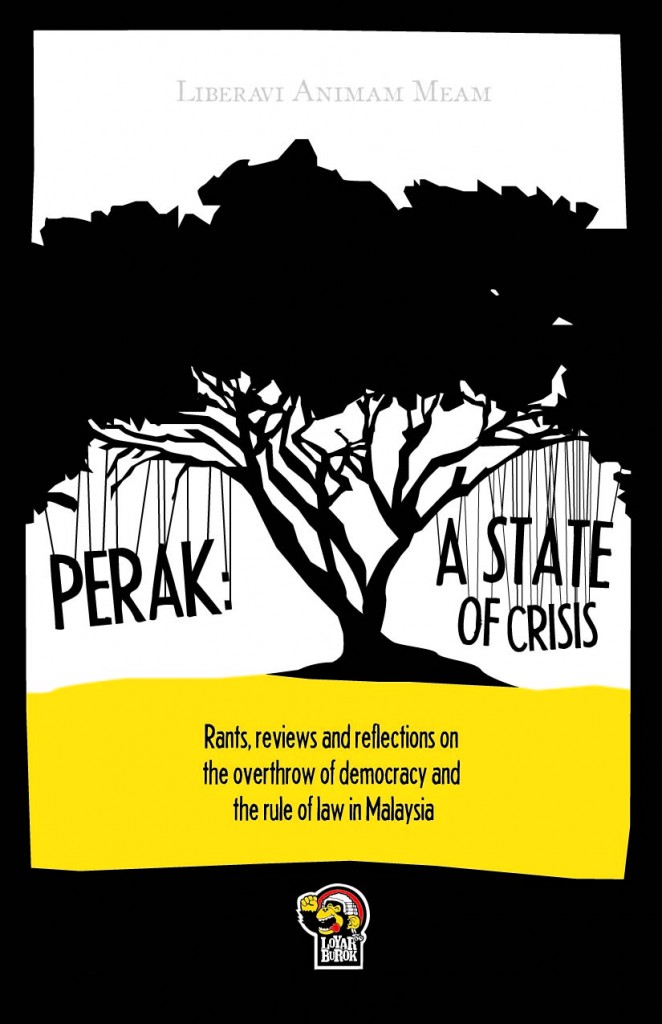
The LoyarBurok Book Review: “Perak: A State Of Crisis” – Re-invoking Our Sentiments

The LoyarBurok Book Review: “Perak: A State Of Crisis” – Re-invoking Our Sentiments
First published on Loyarburok.com on 9th January 2011

LoyarBaca's PASOC: If democracy is what you want, this is THE book for you - from the people who brough you the ONLY blawg, LoyarBurok

LoyarBaca’s PASOC: If democracy is what you want, this is THE book for you – from the people who brought you the ONLY blawg, LoyarBurok

PASOC is now available at most MPH, Borders and Times bookstores through LoyarBaca’s distributors, GerakBudaya. Get yours at those bookstores or hereThe book is into its first reprint (second impression) after having all 1000 copies distributed in 5 days after its mega  1212 launch.

Malaysians have short memories. It was not too long ago that the Perak crisis took place, inducing great disbelief and anger amongst many. But time heals all things, and there’s nothing that good public relations cannot gloss over. Indeed, what happened in Perak almost two years ago may have just faded slowly in our minds – the stark reality of how powers can be so easily misused in the wrong hands – without having been reminded once again through this most valuable and timely book by LoyarBurok‘s publishing arm, LoyarBaca.

Reading “Perak: A State of Crisis” in one sitting is reliving the past – those few months in 2009 during which the Pakatan Rakyat government in Perak was so disgracefully usurped from its position to be replaced by the “new” Barisan Nasional government. The book, a compilation of 20 articles, many of which were written for the LoyarBurok blawg (www.LoyarBurok.com) itself throughout the unfolding of the crisis, walks you through the scenes as if you were there, conjuring up images of what happened at the State Assembly and its compound, the Perak Palace, the famous tree and the courtroom. The well-documented timeline is also helpful to traverse through the incidents as they took place.

Contributors to the book are a combination of lawyers, a former judge and academic experts in the law, hence their approach of the incident through legal lenses. However, far from making use of legal jargon the rest of us are so unaccustomed to, they explain the issues surrounding the Perak crisis and the reasons they have so taken those positions based on the Perak Constitution and judicial precedent in a style easily understood by laypersons, methodical and step-by-step as their profession so requires.

In short, the incident that precipitated this constitutional crisis was the resignation of three State Assemblypersons from their respective parties [one from the Democratic Action Party (DAP) and two from Parti Keadilan Rakyat (PKR), both parties within the Pakatan Rakyat (PR) coalition government] to become Independent Legislators, changing the balance of numbers in the State Assembly with PR and BN having 28 seats each in the 59-seat Assembly. This then set upon a series of events that eventually toppled the democratically elected PR state government with the Sultan of Perak deeming Nizar Jamaluddin to have lost the confidence of the State Assembly thereby appointing Zambry Abdul Kadir as the new Menteri Besar. More than six court cases ensued.

Most authors make repeated reference to Article 16(6) of the Perak State Constitution as this is central: “If the Menteri Besar ceases to command the confidence of the majority of the members of the Legislative Assembly, then, unless at his request His Royal Highness dissolves the Legislative Assembly, he shall tender the resignation of the Executive Council.”

The salient points raised and addressed in the book, which were also litigated on in the courts, are as follows:

1.    Who determines that the Menteri Besar has ceased to command the confidence of the majority in the Legislative Assembly?

2.    What are relevant matters in assessing whether the Menteri Besar still commands the confidence of the majority in the Legislative Assembly?

3.    Can the Head of State determine that the Menteri Besar has lost the confidence of the majority in the Legislative Assembly in a way other than by a vote on the floor of the Assembly?

4.    Can the Head of State refuse the request of the Menteri Besar to dissolve the Legislative Assembly, and following this, dismiss the Executive Council when the Menteri Besar refuses to tender the resignation of the Executive Council?

5.    Can the Head of State appoint a new Menteri Besar if he judges that the present Menteri Besar has lost the confidence of the majority in the Legislative Assembly and does not resign?

Lawyers Art Harun, Kevin YL Tan and former judge NH Chan are the most prolific writers, providing lengthy pieces which cover necessary ground in replying to the questions above, elaborations and conclusions of which are too long to cover in this piece. Other contributors provide their perspectives on particular areas of the crisis, with lawyer Shanmuga K for example discussing whether the Perak Speaker can appoint private lawyers and concludes that the law allows for this. The book ends with three concluding remarks, by Kevin YL Tan, constitutional law academic Shad Saleem Faruqi and jurist on constitutional law Andrew Harding.

It is interesting to note the variances of opinion between the three experts – Shad Saleem Faruqi’s especially differs from the others. He is the only writer to note that the Speaker Sivakumar publicly stated he would not allow the three Independent Assemblypersons to enter the State Assembly, hence making it impossible for them to participate in the vote to determine confidence in the Menteri Besar. He is also the only writer to say that Article 16(6) of the Perak Constitution is open-ended about how confidence of the majority of the Menteri Besar is to be determined. While other writers in the book believe this is only determinable by the floor of the Assembly in session itself, Faruqi states that the clause talks of the “confidence of the majority of the members of the Legislative Assembly” and not the confidence of the Assembly, and that “the action of members acting individually may count”. The consensus among all authors though is that the series of actions or inaction were politically tinged and the best way to restore order would have been through dissolution of the State Assembly and for fresh elections to be held.

One thing is clear about all that took place: the concerted effort by the various institutions to bring about the PR state government’s downfall. The judiciary, the police, the Election Commission and the civil service, all supposedly independent institutions, showed their adherence to the political powers that be. The most appalling picture of Speaker Sivakumar being physically dragged from his seat is the face of humiliation. How is it possible that the BN government cares not for its international reputation in an exercise of brute power such as this?

The book’s greatest significance is ultimately the ability to re-invoke our sentiments – both emotional and intellectual – that accompanied the Perak crisis of 2009. It is a wake-up call (again) that matters of political governance and administration affect all layers and walks of society. That it was edited by a corporate lawyer (as opposed to a human rights one), given a foreword by the Chief Executive of a policy think-tank, with information supplied by journalists encapsulates the point that politics is something everyone must be concerned with as it affects us all. It is also interesting to note the compilation includes selected comments from the articles when they were first posted online, which reflects the sort of dynamic interaction and exchange that now takes place within the legal and public policy community. It is a must-read for anyone interested in political discourse, constitutional law, human rights and public policy.

The Perak case is significant to all Malaysians, as its implications are far-reaching not just for other state governments but also at the national level, especially as discussion is underway on the relationship between the civil service-royalty-political parties in the state of Selangor presently. Finally, Andrew Harding’s conclusion in the book rings true: “The people will decide”. This holds even more weight as the next General Elections loom ahead, with talk of it to be held as early as this year.

Will the Perak voters remember? Only the polls will tell.

Posted in Elections, General Politics, The Cause | Leave a comment

Comparing the state budgets of Penang and Selangor (2011)

How time flies. Back in 2010, we were just charting out the second only Selangor state budget for the year ahead in 2011. This was my comparison between the budgets of Penang and Selangor, written in December 2010 for the Penang Monthly.

Comparing the state budgets of Penang and Selangor 

Penang and Selangor are the testing ground for alternative and future styles of governance in Malaysia. What will be decisive in the long run is not so much the points gained in the daily rhetorical sniping that seems to be an inescapable part of a two-coalitional politics, but how well the state governments are run. The state budgets are therefore what analysts should be studying.

Amidst the noise and clamour of Malaysia’s politics, it is easy to forget that daily responsibilities continue for governments and bureaucrats. The Pakatan Rakyat (Pakatan) coalition for example, has suffered several recent shocks, namely the twin by-election losses in Galas and Batu Sapi, followed by the damage control it has had to put into action following Zaid Ibrahim’s decision to quit the Deputy Presidency race. These events have occupied much media space.

Whilst Pakatan’s political resilience is an absorbing issue, it is perhaps more important to examine the ways in which Pakatan state governments are running their states respectively. This is a more appropriate reflection of Pakatan’s philosophies translated into reality. For example, both Penang and Selangor state assemblies tabled their respective 2011 budgets recently. As two states that contribute significantly to the nation’s wealth and economic development, it is in the interest of all stakeholders (including the Barisan Nasional Federal Government) to ensure these states are properly run and managed in order to continue attracting domestic and foreign investment. A crucial aspect of this lies in the financial management of the states’ resources. Some common themes can be easily identified between the two state budgets.

First, both state governments seem confident about developing more efficient financial management tactics, and eventually shoring up better state reserves in the mid to long-term. Penang tabled a 2011 budget of RM897.36mil, a 25.7% increase compared to its 2010 budget of RM713.79mil. Out of this, 38% contributes to operating expenditure (RM343.1mil) and 62% to development expenditure (RM554.26mil). Selangor tabled a 2011 budget of RM1.43bil, a 3.4% reduction from the 2010 budget of RM1.49bil. Out of this, 58% contributes to operating expenditure (RM860mil) and 42% to development expenditure (RM600mil).

Penang tabled a deficit budget of 12% for the year ahead, whilst Selangor tabled a balanced budget. Selangor’s Opposition Leader was nevertheless keen to criticise Selangor for its RM65mil budget deficit in 2009 during the recent budget debates. The reason given for a deficit in Penang was the social welfare allocations for targeted groups like senior citizens, the hardcore poor, schools and religious programmes. However, Chief Minister Lim Guan Eng stated that the deficit was funded by state reserves, and that he was confident the balance in the reserved funds would increase by the end of 2010 through cost-cutting measures and an increase in revenue. Selangor’s response was similar, with Menteri Besar Khalid Ibrahim saying that state revenues had exceeded its original estimates, and that with better revenue collection methods, state revenues and reserves would increase the following year.

Penang’s government was especially proud of the flattering mention in Transparency International’s and the 2010 Auditor-General’s (A-G) reports of its efforts to heighten transparency in governance and increase efficiency in financial matters. The A-G report especially, commended the government for the increase in its accumulated fund of RM75mil in 2009 compared to 2008. Penang also registered a 1.4% increase in state revenue. As for Selangor, a newspaper report mistakenly quoted from the same A-G report that RM977.7mil was apparently missing from its state accounts, when only RM206mil remained to be adjusted. The full amount was in fact accumulated over a period of seven years. Furthermore, close to 90% of Selangor’s debts of RM829mil (due to loans taken from the federal government) were incurred when the previous administration decided to privatise its water services industry, a move the current government is attempting to reverse. Clearly a deep financial mess was left behind in Selangor, which impacts upon present accounts.

The 2011 budget speech nevertheless shows how an array of measures has been taken and will continue to be taken to increase state revenue further – mainly via the collection of quit rent arrears through land and district offices. Selangor has also successfully collected RM390mil in debts owed it by the Talam Corporation, and has used part of this to start its microcredit scheme for small-time entrepreneurs and the poor.

Second, both states highlighted the need for a specific roadmap and blueprint to outline their vision, what each wants to achieve and how they are to go about it. These are both mentioned in the respective leaders’ speeches. The Penang Blueprint is being prepared by the state think-tank, the Socio-Economic and Environmental Research Institute (SERI), and is soon to be unveiled, while the Agenda Rakyat Selangor (Selangor People’s Agenda), prepared by the state’s Economic Planning Unit and the Menteri Besar’s Office, is to be launched at the beginning of next year. Although the documents are not yet published, the budget speech gives a good indication of their contents. This is all the more necessary since there are such high expectations put on the leadership of the Pakatan. Although the methods may differ, both roadmap documents are a result of extensive consultations with various stakeholders and representatives of the business world and civil society, as well as the community at large.

In promoting the economy, both states pinpointed similar industries to concentrate on. Both Penang and Selangor for example focus on policies aimed at clean, green, sustainable and liveable environments for citizens as both recognise that any economic growth will require comfortable urban living which will in turn attract investment. Specifically, the areas most discussed are the industrial sector, tourism, infrastructure and utilities, agriculture and livestock, trade and consumer affairs, education, the environment, job creation, liveable cities, public transport, cleanliness and safety, urban renewal, rural development, and selected land reform measures. State governments have jurisdiction over natural resources, hence the need to ensure that these are carefully managed. Of course the states are very different in makeup; their population size, pressing needs and expectations, existing infrastructure and proposition points vary, but the direction towards sustainable living is found in both their agendas.

This list may seem like a hodgepodge of issues that throws in everything and anything possible – especially when state governments today have limited purview over major policies due to the increasing centralisation of powers by the federal government. However, the states’ interest on many of these issues is necessary and there are attempts at tackling some of the more difficult problems faced by the people. For example, handling crime or public transport is not necessarily the responsibility of a state government but because people consider these priority areas, both Penang and Selangor have taken the initiative to outline their end-goals. Some of these may involve working closely with the Performance and Management Unit (PEMANDU) under the Prime Minister’s Department. Despite justified criticism of the latter’s ostentatious budget, some bipartisanship will be needed.

Prevalent within both documents is also the emphasis on good governance, transparency and accountability. The theme of “competency, accountability and transparency” continues, cutting across all layers of administration. Both state governments have taken bold strides towards the Freedom of Information Enactment, started open tenders for new contracts, and championed the rule of law. Selangor has initiated the Integrity Pact for state companies such as Kumpulan Semesta Sdn. Bhd. and Perbadanan Kemajuan Negeri Selangor (PKNS). These were announced in the budget speeches, and are expected to be discussed in the blueprints.

Finally, both state governments strongly focus on social welfare programmes. Manifestos from Pakatan parties announced before general elections in March 2008 contained demands for better social safety nets for those in need and for marginalised groups, which the state governments have been trying to live up to. As a result, both states adopted policies aimed at assisting the elderly, Chinese and Tamil language schools, the disabled, religious schools, and mosques and religious teachers. Selangor has some additional welfare benefits for victims of domestic abuse and children of estate workers, a fund for all children born in the state, and a policy of free water for the first 20m3 used per household. State governments are in an awkward position as they do not have authority in determining broad economic policy, but more will be expected of the Pakatan states in determining an economic model distinctively different from the Barisan Nasional style of mega-projects and financial handouts.

It is positive to note that both Selangor and Penang have common goals and ideals in attracting investment, and making their states liveable and sustainable. More could certainly be done in collaboration with the other Pakatan states to create an economic and investment corridor. This would then surely show that in Malaysia’s development, there are alternatives to pumping RM5bil into a 100-storey tower.

Posted in Elections, Selangor | Leave a comment

Islamic matters in Pakatan states

We are likely to see the race and religion cards being pulled as we approach the 13th general election campaign. One accusation often made is that Pakatan Rakyat, in particular the DAP, has not emphasised Islam enough. A tough nut to crack, here is my take back in 2010 on what the Pakatan states did on Islamic matters in both Selangor and Penang.

Islamic matters in Pakatan states

Malaysian political culture seeks to politicise everything under the sun, and nothing is as easily politicised as religion. With the rise of a two-coalitional system, the public has a chance to discuss religious values that go beyond mere political posturing.

Political competition between the Barisan Nasional and Pakatan Rakyat coalitions is predicated on numerous fronts, the more sensitive of which involves religious matters.

There is certainly a long history of political parties continually trying to outperform each other in being more “Islamic” in theory and practice. This holds true especially for the United Malay National Organisation (Umno) and Parti Islam SeMalaysia (PAS). This article explores policy reform areas that have been prioritised by Pakatan Rakyat state governments in Penang and Selangor with regards to Islamic affairs.

The two and a half years of Pakatan Rakyat governing in these states have been peppered with incidents that reflect the complexities surrounding religion. For example, in 2008 when the Penang state government used the Arabic phrase “Amar Ma’aruf Nahi Mungkar” meaning “Enjoin what is good and forbid what is evil” in banners and posters put up across Penang, Chief Minister Lim Guan Eng was accused of being unqualified to state those words, being a non- Muslim. More recently, his name was alleged to have appeared within the pre- determined khutbah text used during Friday prayers in place of the Agong’s name. There was also a doctored photo of Lim slaughtering a cow for Muslim consumption.

In Selangor, a member of parliament from the Democratic Action Party (DAP), Teo Nie Ching, was criticised for having delivered a short speech within the premises of a mosque. A letter was later sent by Majlis Agama Islam Selangor (MAIS), or the Selangor Islamic Council, stating that she needed to obtain its permission before visiting any surau or mosque in Selangor.

All of the above incidents have been played up by government-friendly media, leading to the perception – or with the intention that the perception is formed – that the Pakatan Rakyat coalition
does not adhere to Islamic principles, thus “disqualifying” it from being a government genuinely representing and serving Muslims in Malaysia.

Improvements to policy

Every state has a religious council and department respectively. In Selangor, they are the MAIS and Jabatan Agama Islam Selangor (JAIS) or the Selangor Islamic Department. The corresponding bodies in Penang are Majlis Agama Islam Pulau Pinang (MAIPP) and Jabatan Agama Islam
Pulau Pinang (JAIPP), or the Penang Islamic Council and Penang Islamic Department. The councils generally formulate policies which the departments thereafter implement.

The state religious councils of MAIS and MAIPP are federal agencies, whilst the state religious departments JAIS and JAIPP are theoretically state- level agencies. Councils are therefore largely autonomous from the state governments themselves, with the exception of representation on their board.

Because JAIS and JAIPP are state agencies, the state governments make decisions on aspects such as financial contributions and the nature of such assistance. Their funds therefore are channelled through the respective state governments. The difference between the two states lies perhaps in the fact that in Selangor, the religious head (ketua agama) is the Sultan of Selangor, whose edict is required for major decisions such as the selection of the JAIS director’s position, whereas Penang does not have such a personality whose approval is needed for any religious matters. The state exco in charge of Islamic affairs would generally make decisions in conjunction with the religious departments after discussion, although there have been occasions when they may seem to have conflicted with state government ethos.

Prior to Pakatan Rakyat taking over the governments in Penang and Selangor, Sekolah Agama Rakyat were neglected. These are schools that operate indepen-dently and quite separately from the state religious department-funded Sekolah Rendah Agama. This explains the percep-tion that they are counter-cultural. These Sekolah Agama Rakyat were born out of individual Muslim families who wanted to provide an alternative, holistic education option for their children which was based on Islamic values and principles.

There are 250 such schools in Selangor at both primary and secondary levels. Whilst no funds were given to them by the previous Selangor government, the Pakatan government allocates RM6mil annually to these schools. Similarly, the Penang state government also provides hardware and basic provisions to the Sekolah Agama Rakyat, something which was neglected by the previous state government.

The Selangor state government also increased the allowance for guru kafa, or kafa religious teachers, to RM1000 for normal teachers (previously RM700). Additionally, a specific education council has been initiated, Majlis Permuafakatan Institusi Pendidikan Islam Selangor (MAPIS),
which pools teachers from these Sekolah Agama Rakyat and provides additional teacher training courses, since many are either diploma or Sijil Pelajaran Malaysia (SPM) holders with no formal teaching training. Books, basic amenities and elec-trical wiring systems are also provided under the new support scheme. The state government also encourages more learning programmes within mosques, through tazkirah and knowledge seminars.

Although it seems petty to make superficial comparisons on monetary contributions, it is worth mentioning that financial contributions to Islamic affairs have increased significantly under the Pakatan Rakyat governments. For example, the Penang state government contributed RM20.5mil to Islamic matters in 2009 and RM24.3mil in 2010, more than double what the previous state government allocated (RM12.5mil in 2008). Similarly, the Selangor state government contributed RM136 million in 2009 and RM149 in 2010, compared with RM130 million in 2008, close to a 20% increase. (These figures do not include what is allocated to the Sekolah Agama Rakyat, which, as mentioned above, is a significant variation under the new state governments).

Other practices

There have been other more significant policy improvements that are reflective of good governance, transparency and public accountability – the grounding principles of most religions including Islam. The Penang state government has, for example, made public its practice of open tenders in which 70% of Penang Development Corporation tenders and 67% of those from Perbadanan Bekalan Air Pulau Pinang (PBAPP) were won by Malay contractors. This proves that healthy and transparent competition would allow the Bumiputera community to flourish. In Selangor, the Merakyatkan Ekonomi Selangor programme, consisting of seven social welfare-based packages, has essen-tially reached out to all residents within Selangor regardless of race and religion. Malays, naturally making up a majority of the population, would be immediate beneficiaries of such programmes.

All this should dispel the notion that the new governments are unable to cater to Muslim needs. However, this causes us as Malaysians to be trapped in the same web of petty comparisons, a competition based on one-upmanship.

The reality is that religion will always colour politics in Malaysia. The better path to tread is one that allows the embracing of more meaningful Islamic principles such as truth, accountability and good governance instead of the debating of who should be allowed into mosques.

Genuine reform must mean a deeper and more conscientious development of policies truly reflective of the religion that shapes much of the Malaysian way of life.

Posted in Ethno-Religious Politics, Religion, Selangor | Leave a comment

Civil servants at an Impasse

As we approach the 13th General Election, it is relevant to note that should Pakatan Rakyat take over the federal government, one of the most contentious issues is that of dealing with the civil service. Let’s take a look at the past experiences of Selangor and Penang, in how these state governments dealt with the matter from 2008 onwards. An old piece but good to reflect, first published in the Penang Monthly in 2010.

Civil servants at an impasse

The tension between federal and state governments is oft en played out in the civil service. This makes it necessary for Malaysians – and especially civil servants themselves – to contemplate the ideals surrounding civil services in general. To do that seriously, some knowledge about how civil service structures differ from state to state and why they differ is required.

Since taking over several state governments, one of the areas the Pakatan Rakyat has had to contend most with is the civil service. A majority of the bureaucrats working within the state governments are federally appointed, especially higher-ranked officials from the prestigious Administrative and Diplomatic Service (Pegawai Tadbir dan Diplomatik).

This situation has been problematic for all involved, especially when these public servants have to serve the state government of the day on the one hand and report to the federal government on the other. The confusion is worse when policy directives from the two levels of government are in clear conflict with one another.

This tense relationship came to a head in July this year when Penang Chief Minister Lim Guan Eng’s dissatisfaction with State Development Officer Nik Ali Mat Yunos became a widely reported tiff in the media. Lim had publicly criticised Nik Ali on several matters, including the construction of arches at the Penang Botanical Gardens costing RM15,000 which the state government had no control over, and reportedly called him incompetent and unprofessional. Nik Ali retaliated by calling the Chief Minister rude at a press conference. He was later defended by the Chief Secretary to the Government Tan Sri Sidek Hassan.

This incident encapsulates hostilities between the Barisan Nasional federal government and Pakatan Rakyat state governments. But to what extent can the civil service be expected to separate their duty from what is expected of them politically?

This particular incident can be considered unique because the State Development Office (SDO) is a separate unit set up directly under the purview of the Implementation and Coordination Unit (ICU) that falls under the Prime Minister’s Office. When the Pakatan Rakyat took over in Penang and Selangor, the SDO were physically removed from their premises at the respective state secretariat buildings and now exist completely isolated from the state governments’ plans, policies and programmes. They do not report to the state governments.

Selangor has not been spared similar controversies. During the Select Committee on Competency, Accountability and Transparency (SELCAT) public inquiry into assemblymen’s allocation of funds in 2009, federally-appointed civil servants within local authorities were visibly unhappy. They had been questioned on their approval of former politicians’ development projects, many of which involved large sums of money. They protested against SELCAT’s questioning, saying it was humiliating in nature. Their defence was they were merely acting on instructions from their then political masters.

In order to understand the nature of the relationship between the state government and its employees, it is important that we first examine the public service’s existing structure.

Malaysia’s civil service

The Malaysian Civil Service emerged from the British Public Service which began in the late 1700s after the British East India Company acquired Penang. In the late 1800s, the Federated Malay States’ separate civil services (Selangor, Perak, Negeri Sembilan and Pahang) were combined with that of the Straits Settlements (Penang and Malacca) into a unified Federated Malay States Civil Service (FMS). The FMS later introduced the Malay Administrative Service and together they refined new standards for public service. The Unfederated Malay States (Johor, Kedah, Kelantan and Terengganu) on the other hand formed and today still maintain their own State Public Services under the authority of their respective Menteri Besar and Sultan, where most of their state civil servants are employed by the state.

Other colonial services like that of the Police, Medical, Education and Legal were brought together over the years, forming the Colonial Administrative Service that the Malaysian Civil Service (MCS) was part of, the latter of which is known today as the Administrative and Diplomatic Service mentioned above. This is seen as a prestigious level of service which fills almost all senior positions at the federal and state levels.

The Malaysian public service today has a total of 1.2 million employees covering 28 schemes of service. Public service policies are crafted by the Public Service Commission (Suruhanjaya

Perkhidmatan Awam) and thereafter executed by the Public Service Department (Jabatan Perkhidmatan Awam), although neither of these have jurisdiction over the public services of former members of the Unfederated Malay States. This federal-level Public Service Department is responsible for the appointment and promotion of officers higher than Grade 17, which is the entry point for those with high school certificates.

Selangor is unique among the Federated Malay States in having its own public service, albeit on a smaller scale, having the power to fill junior positions and only within state government departments. The Selangor Public Service Commission was formed in 1960 to aid the existing Federal Public Service. The Commission is governed by policies such as the Public

Officers Regulations of Selangor State Government (Appointment, Promotion and Termination of Service) from 2005 and other circulars from the State Administration. Based on their 2008 annual report, the Commission spent RM560,000, the bulk of which was on salaries for some 1,778 employees. This state-based civil service only allows appointments up to a certain level, after which posts are filled by federal officers seconded to the state government.

Penang had a similar limited state-based civil service in the past that went up only to the Assistant District Officer level. However, in the 1970s, in response to a petition from civil servants from those states itself, the civil service was merged with the federal civil services so that Penang officers could be promoted to the highest rank possible.

In both Selangor and Penang, most public servants are federally appointed and seconded to the individual state governments. Selangor employs a total of 7,984 people, while Penang employs

4,196, excluding those employed in local authorities and statutory bodies. Selangor pays its employees a total of RM271.8mil a year in emoluments, which makes up 38.31% of its annual budget, whilst Penang pays out RM115.9mil a year, making up 36.4% of its annual budget.

Independence of the civil service

In 1845, the Northcote-Trevelyan Report, which prescribed public service ethos, emphasised that a politically neutral civil service “means complete loyalty to the government of the day regardless of its political complexion” (taken from the Chief Secretary’s website). It also stipulated that the public service should provide continuous services which are impartial and appropriate for public interest.

A change in government should not precipitate instability or chaos. In both the state governments of Penang and Selangor, there have been varying reactions to the change in government in 2008. In some instances, civil servants were naturally wary. However, after more than two years of working with their state governments, many have understood the principles of Pakatan Rakyat of competency, accountability and transparency, and some have been enthusiastic in delivering upon these.

Nevertheless, there is still room for improving the working relationship between the civil servants and the state governments they serve, especially given that other instructions will continue to come from Putrajaya. One still recalls the directives from the Ministry of Education not to allow Pakatan Rakyat elected representatives into public schools, and the Minister of Agriculture instructing all its officers including those seconded to state governments not to attend any official state function.

The state’s delivery of public services depends largely on the efficiency and professionalism of its civil service. In a recent Selangor 2011 Budget Dialogue, a federally-appointed civil servant asked what they should do in situations where there were conflicts of policy between the federal and state governments. The panel replied that public servants should ultimately do what is in the best interest of the people. For the betterment of Malaysia, civil servants must conduct their work with wisdom, independence, professionalism and political neutrality.

Posted in General Politics, Selangor | 3 Comments

Information in restricted public space

Despite being in government in 4 states, Pakatan Rakyat has had to battle it out in the online space because of restricted media coverage in mainstream papers. Published in The Penang Monthly in August 2010, this article (and others to follow) are included in my book The States of Reform, written specifically on the Selangor and Penang state governments.

Information in restricted public space

Perhaps the most decisive battle between Malaysia’s two coalitions is being fought in the information arena, and not in by-elections or in parliament. As in most countries, ownership of the mass media affects the level of press freedom greatly. But when draconian laws are also in place strangling information flow, as in Malaysia, then we have a serious problem. However, necessity is the mother of invention.

One of the fundamental pillars of any modern democracy is a free mass media. It is through transparent and responsible reporting by independent journalists that the public is provided with unbiased information and can form opinions based on it. In a healthy political environment, ideas flow freely and a variety of alternatives are available for public consumption.

Unfortunately, this is not the case in Malaysia. Freedom House’s 2010 Freedom of the Press world ranking exercise places Malaysia at 142nd out of 196 countries surveyed, which puts us in the world’s bottom 30% of countries in the area of press freedom. Neighbours like Indonesia, the Philippines, East Timor and Thailand are ahead of us.

The inherent problem is that media ownership is concentrated to a few who are closely linked with the ruling coalition government. The current media conglomerates are namely:

i.            Media Prima, which is aligned to the United Malay National Organisation (UMNO), is a major shareholder in the New Straits Times Press, which publishes The New Straits Times, New Sunday Times, Berita Harian, Berita Minggu and Harian Metro; and owns TV3, NTV7, 8TV and Channel 9, as well  as radio stations Fly.FM and Wafm;

ii.            Huaren Holdings, which is the investment arm of the Malaysian Chinese Association (MCA), owns The Star, Nanyang Siang Pau and China Press;

iii.            Utusan Melayu (M) Bhd group, which is also linked to UMNO, owns Utusan Malaysia, Mingguan Malaysia, Kosmo! and a range of Malay-language magazines; and

iv.            Other Chinese-based newspapers such as Sin Chew Daily, Guang Ming Daily and Oriental Daily, owned by business tycoons.

Given the concentration of media power in the hands of the politically well-connected, opposition parties have always had a hard time getting fair coverage. Newspapers critical of government policies or personalities have been invariably threatened, resulting rather quickly in editorial self-censorship. Earlier this year, an NTV7 producer resigned in protest over his company’s decision to stop his talk show from commenting on the upcoming by-election at Hulu Selangor, following pressure said to have emanated directly from the ruling coalition. A TV2 documentary on the controversial Bakun Dam and the forced relocation of Sarawak’s natives was forced off the air, just before the Sibu parliamentary by-election took place. It is clear that open debate has little room to flourish in Malaysia. The sort of Prime Ministerial debates recently carried out in Britain are obviously not the sort of thing our federal government is confident about handling.

The Centre for Independent Journalism found that in the lead-up to the 2008 elections, reporting in The Star (63%) and Utusan Malaysia (82%) strongly favoured the Barisan Nasional.

The second major problem is the legal framework within which the mass media operates. The Printing Presses and Publications Act (PPPA) states that the Minister of Home Affairs has the authority to grant, renew and revoke printing licences and publishing permits. This is, and has been used as, an easy tool of control. Most recently, for example, the Home Ministry suspended the publishing permit of Parti Keadilan Rakyat (PKR)’s newspaper, Suara Keadilan, for allegedly going against the PPPA in an article claiming that the Federal Land and Development Agency (FELDA) was bankrupt. The Ministry is not happy with the explanation that Suara Keadilan had provided so far, and is demanding a “satisfactory explanation”. What is satisfactory is at the arbitrary behest of the ruling government.

Other laws that have restricted the press from acting freely and independently are the Official Secrets Act 1972, the Internal Security Act 1960 and the Communications and Multimedia Act 1998, all of which have essentially suppressed the freedom of expression in Malaysia. Whilst it is important that information affecting national security needs to be controlled, many of these restrictions should be lifted. Given the comprehensive web of constraints, the Internet – when it appeared – was a welcome haven for alternative news. This was especially prominent during the general election in March 2008. Online mass media sources currently include the pioneering Malaysiakini, Malaysia Today, The Malaysian Insider, Merdeka Review, The Nut Graph and newcomer Free Malaysia Today, all of which act as alternatives to mainstream media.

Although there have not been any website bans imposed by the government – the Malaysian Communications and Multimedia Commission (MCMC) scrapped an initial plan to use filters on the Internet to “curb pornography” last year – threats against such sites and against bloggers exist, for example, against outspoken blogger Raja Petra Kamarudin who was sued for criminal defamation for an article hosted on his site. Malaysiakini continues to suffer harassment, with its people being interviewed for eight continuous hours in 2009 over its video on protests that had taken place at the Selangor state building.

With such stark controls on both the mainstream and online media, it has been interesting to observe the measures taken by Pakatan Rakyat-controlled state governments to circumvent the biased news reporting against them. After all, the only way a government is able to effectively publicise and communicate its positive policies and programmes is through popular media. How then would these governments – in Penang and Selangor, for example – broaden their access to the voting public, apart from maintaining official websites such as www.penang.gov.my and www.selangor.gov.my?

Some alternatives are indirect, such as the initiative taken by Socio-Economic and Environmental Research Institute (SERI) in late 2009 to revamp its circular, the Penang Economic Monthly (the magazine this column appears in). The magazine focuses on economic and cultural affairs, and is sold in and outside of Penang, acknowledging the large dispersal of Penangites living and working in the Klang Valley and beyond. This has been received well, largely because its scope is comprehensive, and it covers in a semi-academic fashion political, economic, historical and social issues that concern the state of Penang as such.

The magazine has in fact been used on a couple of occasions by the Penang opposition, meaning UMNO, in the state assembly to debate against the state government!

It is as yet not clear whether the government of Penang will publish its own state newspaper in the near future.

The Selangor state government has a more structured communication package, which includes a Selangorkini monthly newspaper that is distributed throughout the state, targeted at the Malay rural heartland. It also has an online version of the newspaper, but updated daily at www.selangorkini.com.my and www.tvselangor.com, a Web TV which has both news and live online video streaming showcasing the State Legislative Assembly and Selangor Select Committee on Competency, Accountability and Transparency (SELCAT) sittings. Selangor is also expected to table a Freedom of Information (FOI) enactment in the state assembly, which adopts the right to information as a rule of thumb, and only lists restrictions affecting national and state security amongst others.

Such efforts are creative methods found in Pakatan states that reach out to the public. However, communication between government and people continues to be a problem.

Leaflets, circulars and inserts into existing party organs like the Democratic Action Party (DAP)’s The Rocket, Suara Keadilan and the Pan-Malaysian Islamic Party (PAS)’ Harakah are used to disseminate information. However, the Merdeka Center for Opinion Research polls show that the majority of Malaysians still rely on information obtained through television and mainstream newspapers to form their political opinions. Whilst Chinese-medium newspapers have been generally fair in the reporting of news from Pakatan Rakyat state governments, the same cannot be said of Utusan Malaysia.

There is certainly room for improvement and increased engagement, especially when the population is hungry for interaction with their state and local governments. Social media is an example that can be capitalised upon, such as Facebook, Twitter, personal websites and blogs, and so on. State leaders have adopted these although not optimally; Penang Chief Minister Lim Guan Eng, Selangor Menteri Besar Khalid Ibrahim and a horde of State Executive Councillors, Members of Parliament and State Legislative Assemblymen are taking their political battles – sometimes with great wit and sarcasm – onto the Internet. Technological developments will therefore offer opportunities for greater public involvement, despite restrictions. The recently launched offshoot of Malaysiakini, Komunitikini.com, for example, can offer excellent ways for local councillors to promote local events and issues.

Necessity is the mother of invention, as the saying goes. Pakatan state governments have therefore to think up new and unique methods to overcome blockages on the information highways. There is still much room for improvement.

However, Malaysia cannot proclaim itself a First World, high-income, progressive and developed country as long as it continues to exert a stranglehold on its mass media. Worse, such legal and political pressures have lowered the quality of writing, debate and speeches to an embarrassing level.

Structural and legal reforms are imperative if Malaysia is to mature properly.

Posted in Media, Selangor | Leave a comment

I am what I believe

I was invited last Friday to speak at an event jointly organised by Empower and SIRD (Strategic Information and Research Development Centre) entitled “I am what I believe”. A rather intriguing topic to begin with, the objective of the forum was to bring a diverse range of youth together to discuss the role of religion in politics and the fine workings between the two. The speakers represented the fields of law (Aston Pava from the Bar Council), feminist activism (Nazreen Nizam from Sisters in Islam), social and community work (Mrithula Shiva from the URI, United Religions Initiative), and public policy (myself).

Though I did not have a text, I was asked to prepare a summary of what I wrote for the purposes of their record-keeping and report. So here we go. A rough outline of what I said last Friday evening at MBPJ, with about 30-odd young people sacrificing their night out to have some solid discussion on the religious-political sphere in Malaysia.

The Relationship between Faith and Politics

Tonight I will speak on two over-arching topics in relation to faith and politics; the first will outline my personal background and the reasons for which I subscribe to the principles I believe in today, and thereafter I will try to address the problems that are currently being faced in Malaysia.

I’d like to firstly put a caveat that I am not speaking on behalf of the state government. However, because I do wear that particular hat, I do have a certain amount of experience and exposure in the realm of policy-making from a state government’s point of view. Hence, I speak as a policy analyst, one with experience in government, and one who happens to have been brought up in the tradition of the Christian faith.

My heritage is therefore one of Christian tradition. Having grown up in an environment of relative conservative spirituality, the ‘church’ had us believe that much of what constitutes Christianity is essentially to do with one’s spiritual health – the relationship between self and God, the divine. Most of our teachings were centred upon how to improve one’s spirituality, with a particular focus on the afterlife. However, as I started becoming exposed to public issues such as corruption, injustice, cost overruns (such as the Istana we are now faced with), abuse of power, discrimination of minorities and a host of other issues, I realised that the public-private divide was a myth, for someone whose faith so fundamentally describes the personhood of someone.

Again, I am only speaking based on my own experience. The division between the public and private spheres in this instance was difficult, especially since the ethos that drove me as a person – those very principles of justice, honesty, truth, accountability – were the same things that I would project onto the public sphere. Faith and politics were hence intimately intertwined insofar as social justice was concerned. For example, the efforts to fight slavery in the past stemmed precisely from faith principles (or the interpretation of what those religious principles were to that particular group of advocates).

My premise is therefore that for those whose faiths so intensely drive their being, it is not possible to extricate one from the other. The problem arises, however, when there are varying interpretations of opinions on public morality; or when policymakers begin to take it upon themselves to consciously legislate public morality. This, again, is entirely possible, if and only if, the leader concerned is able to rationally consider what is the greater good for all. This means that policy decisions must be made for ALL from different backgrounds, and these differences must be taken into consideration.

Living in Southeast Asia and Asia, for example, it is inevitable that any of us would have had some sort of exposure to religion growing up and even at present. To say strictly that there IS a separation of the two is utopian for some but impractical for most. Given this reality, how then do we approach decision-making for the public at large?

Let’s focus on Malaysia right now. The problem in our country is that there is a tight and interrelated nexus between the issues of race, religion and politics. Race and religion so fundamentally describe identity. The nexus is therefore between identity and faith, identity and power, which are extremely strong ties. Without delving too deeply into history, the Iranian Revolution in 1979 without a doubt spurred Muslims in Malaysia towards a religious wave. Again, this is too sweeping a generalisation and I am not doing justice to historical political discourse, but what resulted from these trends were the emergence of political parties in a race towards being more Islamic than the other: UMNO and PAS. I do not doubt the genuine intentions of many, but there have certainly been strategic steps taken for political expediency purposes, on both sides. Therefore this establishes that religion in Malaysia ties too closely with politics for us to have a rational discussion on the theoretical relationship between faith and politics – or rather, the prescriptive notion of what ought to be in place.

In addressing the issue of a secular vs. an Islamic state, I believe the definition of the term secular or secularisation is interpreted differently by different quarters, and therein lies the difficulty of discourse. A secular state does not necessarily mean one that is completely non-religious. This just means that the country is not legally defined or shaped or dictated by those religious principles, for example as mentioned above the legislating of public morality. In any case, even without those legal tags that we place upon Malaysia, can we not be satisfied to say that the country is in fact Muslim in ethos nevertheless?

The more interesting question to me, therefore, is then to what extent can personal beliefs inform our policy decisions? Should they at all? In the courts, through government administration? I believe that faith can inform and influence our decisions, but only to the extent that it benefits the greater good for all. The important consideration is that of people of multiple religions being affected as a result of any public policy decision.

And yet, more and more issues besiege us daily. There are the issues of the “Allah” controversy, temple relocation, church-burning, Kartika and caning as a result of alcohol consumption, apostasy and the list continues. My personal conviction is that we ought to ask ourselves where we are at the cross-roads, where we want to go and how is it we are to get there? We must be able to work on faith principles and common values that can be applied to the public sphere. I can think offhand of initiatives such as working on poverty, the right to water, refugee issues, humanitarian aid, and so on. There is a need to recognise common ground, that of respect, dignity, trust. The Common Word Document that was sent by leading Muslims around the world to the Church community was an epitome of such respect for a common belief in one God and that of loving thy neighbour.

This work has to begin with the young, as I believe some would be too encumbered with baggage of their own beliefs and that of their heritages (including that within the Christian faith) to progress further. More people of such thought projections should be empowered to speak up and express their opinions, without the religious agenda being hijacked by a select few. More avenues must be given, such that religious views are not exclusive to those who are legally or administratively given the right to speak or define one’s personal beliefs. We must be able to break free from the insecurities, fears of identity that have burdened our own communities for far too long.

What are the right avenues to work on this agenda? Through profession (the vocation that one chooses to take up i.e. law, policy), involvement in civil society (NGOs like Perkasa are powerful but to speak up means forming and joining other NGOs to have a critical mass and show voice and power), politics (being involved in actual decision-making or supporting those in politics who share your views), the media and Internet (Web 3.0 is powerful as a source of influencing opinions far and wide). Ultimately, it’s about education and opening of the mind. Remember this. Leaders make decisions based on what they believe the people want. Enough people believing and displaying publicly that they desire traditional, classical religion to be less defined within the law, will eventually lead the way to that end. This, after all, is democracy.

Posted in Religion, The Cause | Leave a comment

Selangor Fulfills Commitment on Right to Information

Download the FOI Draft Enactment HERE.

The idea for a Freedom of Information Act is not a new one. Many a conference and public forum has called for such an enactment even prior to the March 8th General Election. In other countries, it varies from being known as a “Freedom of Information” to a “Right to Information” Act (the latter is true for countries in India). When Pakatan Rakyat stepped into power in Selangor, this was a prime opportunity for the state government to put into practice what it has always called for at the Federal level.

The process was not necessarily an easy or a direct one. The enactment was drafted by several parties, and went under the scrutiny of the State Legal Advisor in its final stages. The issue of the Official Secrets Act (OSA) and how that would work was one issue on everyone’s minds. Administratively, which agencies would be covered? What would the mechanisms be? Who makes the decisions? All these questions are hopefully answered in the draft enactment…

Which has been finally tabled for first and second reading TODAY at the Selangor State Legislative Assembly! Let today be a historic day, with an unprecedented enactment, either at the State or Federal levels. The next step is for the newly elected Select Committee (chaired by YB Saari Sungib) to decide on how to proceed, which would include several rounds of public consultation. After collating the feedback and having various (thorough I am sure) discussions, table it for the third and final reading.

We must ensure that the implementation of this FOI enactment takes place efficiently, lest it becomes a mere justification for living up to our own self-imposed standards of transparency and public accountability. Officers with traditional and conservative views will need to be given training and exposure, to operate on the principle of information availability with only narrow exceptions.

We should also now include as a clarion call for the Federal Government to take up the initiative. In the very least, some reform must be done to address the archaic laws of the OSA, Printing Presses and Publications Act, and a slew of other Acts which have continuously served to restrict and muzzle freedom of expression and of media.

Thanks to YB Elizabeth Wong (Chair of the FOI Taskforce) and team, they’ve compiled the Media Reports below here. Enjoy:

S’gor tables ground-breaking FOI Bill (Malaysiakini)
Enakmen kebebasan maklumat (Malaysiakini)
‘Bil kebebasan maklumat ‘ceroboh’ perlembagaan’ (Malaysiakini)
Selangor merakyatkan informasi (Malaysiakini)
BN says FOI encroaching on Federal powers (TheEdge)
Amid media clampdown, S’gor tables FOI Bill (Malaysia Chronicle)
巫统议员批雪资讯自由法违宪 黄洁冰:阳光是最好的消毒剂 (Malaysiakini)
雪政府提呈资讯自由法 决策与行事摊在阳光下 (merdekareview)
指大臣有解密权无必要立法 国阵:雪州资讯自由法违宪 (merdekareview)
《资讯自由法令》让人民监督政府 拯救被腐蚀的机制 (Therocknews)
BN opposition attacks Selangor’s Information bill (TheMalaysianInsider)

Posted in Selangor, The Cause | Leave a comment

Democratising Women

The July edition of the Penang Economic Monthly is out! This time I co-author a piece with gender expert Dr. Cecilia Ng on the issue of Democratising Women. Gender and politics in Malaysia is changing rapidly with the Pakatan Rakyat having a significant number of women representatives. What have the Selangor and Penang state governments done to advance the gender reform agenda?

Democratising Women

Tricia Yeoh and Cecilia Ng

Part of the excitement associated with the post-political tsunami of March 8th 2008 when Pakatan Rakyat (PR) took over four (now three) state governments was that it signalled a greater democratisation of the country’s polity. This process certainly includes the transition towards making the practice of deeply entrenched public power more transparent and accountable, the debates of which have indeed since flourished at both Federal and State levels. Today, we have both the Barisan Nasional and PR component parties championing the labels of transparency and accountability in a political market competition of sorts, the evaluation of which is at the public’s disposal, and the results of which are tabulated at elections – or so the process ought to be.

That said, another fundamental aspect of this process of ‘greater democratisation’ is that of inclusive citizenship, where all individuals in society should be empowered to contribute to the formation and practice of public policy – the drawing upon private citizens into public spheres so to speak. Academics have argued that although democracy is premised on the idea of universal citizenship where everyone has the right to be treated equally under the law, it tends to reflect the male and heterosexual citizen. The redefinition of politics is therefore necessary to challenge the practice of it being essentially male-dominated and heteronormative.

And Malaysia?

The same is true of Malaysia, whose male-dominant political representation has resulted in gender-skewed policies and practices. Who can forget, for example, one Parliamentarian’s brash remarks referring to a fellow woman Member of Parliament’s menstrual cycle in utterly distasteful humour? More serious, however, are the impacts of such similar strains of thought upon the laws that govern the country, and in turn, the implications of those on women. One of the solutions has been through a model of ‘fast-tracking’ to redress the historic exclusion of women, where more and more countries are adopting quotas, as temporary measures, for increased political representation for women. The goal is to ensure both descriptive and substantive representation of women in the political arena.

There are 13.9 million women in the country, making up % of the national population. The participation rate of women in the Malaysian labour force increased from 44.7% in 1995 to 46.4% in 2009, which is relatively low compared to neighbouring countries like Thailand (70%), Singapore (60.2%) and Indonesia (51.8%). In positions of decision-making, the number of female Members of Parliament increased from 5.3% to 10.4% between 1990 and 2009. Women now account for 30.5% of top public sector management positions in 2010, a rise from 6.9% in 1995. However, in the private sector women only make up 6.1% of Malaysia’s corporate directors.

Continue reading

Posted in Selangor | Leave a comment

Selangor’s Freedom of Information Enactment

It’s taken a while, but the Selangor Freedom of Information Enactment will finally be tabled for its first reading at the upcoming State Legislative Assembly sitting! It will be interesting to see how the Federal Government reacts to this, although they should not be too concerned since only state-related documents will be of relevance here.

BFM Radio interviewed me earlier in the week (it was aired on Monday 7.30am, which I unfortunately missed). The podcast is available here. I spoke about our plans to table the enactment, as well as what the draft roughly contains.

One of the issues was whether or not the Official Secrets Act would interfere with our enactment. The answer (broadly speaking, since there are many technical details that one could write on) is no: Only state-agencies’ information will be made transparently available to the public. Federal agencies’ documents, classified by the Federal Government, are not relevant in this case. However, the Selangor Menteri Besar has the authority under Section 2A of the OSA to declassify certain documents, the power of which he has already exercised numerous times over the past two years (on issues like Bukit Botak etc.).

This is not the final draft yet and there will be several stages to go, like a Select Committee to be formed, public opinion gathered based on the existing document, and then second reading after taking those recommendations and suggestions into account.

Posted in Selangor, The Cause | Leave a comment

World Cup Project: Gol?

Amir Muhammad and team always seem to have some project or other up their sleeve. I appreciate their creativity in a Malaysian society that is just too willing to go with the flow, without any initiative on new and fresh ideas. So their project Gol? is yet another addition, a breath of fresh air to the stale rot, I mean, political condition, of Malaysia. They’ve gathered authors to write on their experiences and thoughts whilst watching the 2010 World Cup being staged in South Africa, from local mamak stalls and such. It’s been interesting to observe the variety of writing styles and content of each author.

I was invited to contribute a piece on the last Quarter Final match, between Paraguay and Spain. Yes, Spain won. And yes, my piece lacks football punditry (I am not a football pundit), and is bone-dry as it analyses history and policy somewhat. But here it is for your consumption.

Paraguay vs. Spain

by Tricia Yeoh

The world is flat, and so is the football field. But the international flavour of any World Cup offers other historical sub-themes that are unseen at face value. Here you have the gathering of once-upon-a-time colonisers and their former colonies, put together in the spirit of apparent sporting unity and brotherhood. Never mind that their forefathers once had you under their thumb for centuries, putting you in a position of subordination. No, the World Cup erases all national memory. Come to the pitch and think about the game. Nothing else matters.

Or does it?

This psychological love-hate relationship of coloniser-colony is something Malaysians have equally struggled with. The British left us with infrastructure, schools, language, and a legal and constitutional framework of governance, which were positive contributions. But they also initiated a divide-and-rule system, conveniently classifying our wide variety of ethnicities into categories of ‘race’, which we have inherited today, causing us to think of Malaysians as largely homogeneous definitions of “Malay, Chinese, Indian”. We have not been able to rise above this particular negative effect the British left behind. In fact, this tragedy and its political consequences may be the singular cause for all other problems faced, including Malaysia’s inability to shine in international football.

This quarter-finals pitted Spain against its former colony, Paraguay. Although Paraguay achieved its independence relatively early compared to other Spanish conquests in South America, almost 300 years of authoritarian Spanish rule had a detrimental effect on their people, in terms of poverty, lack of access to education and undemocratic practices. Paraguay would thereafter succumb to dictatorship and civil unrest, leading it to a struggling economy which still exists today, with about 60% of its people living in poverty.

But their fighting spirit at Ellis Park tonight bore no resemblance to these conditions. Although the first half ended with no goals on either side, Paraguay showed its brute confidence and bravado in pushing forward, never giving up despite their disadvantaged position. They were, after all, up against the team that topped the bookmakers’ odds in winning the World Cup (that is, before Spain’s first game).

Continue reading

Posted in Outside Malaysia | Leave a comment